


The aerospace industry demands zero-compromise precision, material integrity, and quality traceability for every flight-critical component. For procurement teams and aerospace engineers, sourcing reliable CNC machining aerospace parts often comes with pain points: inconsistent tolerances, communication gaps with overseas suppliers, and delayed lead times that derail project timelines.
This guide breaks down every core factor in precision aerospace CNC manufacturing, from material selection and 5-axis processing to AS9100 quality standards and cost optimization. It is built to help you make informed sourcing decisions and reduce risk in your supply chain.
Get a Free Aerospace Part Quotation
The Critical Role of CNC Machining in Aerospace
Precision is non-negotiable in aerospace manufacturing. Even a 0.01mm deviation on a structural component can compromise flight safety, which is why tight tolerance CNC machining is the foundation of modern aircraft production.

Structural analysis of lightweighting strategies in aerospace manufacturing.
CNC machined parts for aerospace serve across every aircraft system, supporting both structural integrity and functional performance. The table below outlines the most common application scenarios:
| Application Category | Typical Components | Core Precision Requirement |
|---|---|---|
| Turbine blades | Compressor blades, stator vanes | ±0.005mm profile tolerance, high surface finish |
| Landing gear components | Bearing brackets, axle sleeves | High fatigue resistance, ±0.01mm dimensional accuracy |
| Fuselage structural parts | Stringer clips, bulkhead fittings | Lightweight design, consistent hole alignment |
| Aircraft engine components | Manifolds, valve bodies | High temperature resistance, leak-proof sealing |
Advanced CNC processes enable the production of complex geometries that were impossible to manufacture with traditional methods, driving innovation in fuel efficiency and aircraft performance.
For a full overview of our aerospace component capabilities, explore our dedicated aerospace CNC machined parts page.
Materials Matter: Machining High-Performance Aerospace Alloys
Aerospace material selection balances three core priorities: strength-to-weight ratio, environmental resistance, and machinability. The wrong material choice can drive up costs by 30% or lead to premature part failure in service.
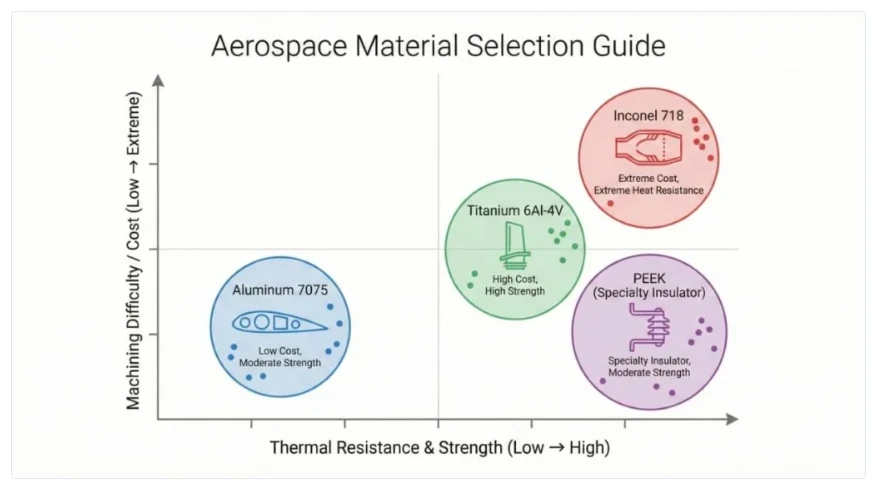
Material selection guide: Balancing cost, machinability, and performance.
The table below compares the four most widely used aerospace materials we machine, with key performance and processing details:
| Material | Key Properties | Machining Difficulty | Typical Aerospace Applications |
|---|---|---|---|
| Aluminum 7075 | High strength-to-weight ratio, good fatigue resistance | Low (excellent machinability) | Fuselage brackets, structural fittings, wing components |
| Aluminum 6061 | Good corrosion resistance, high formability | Very low | Interior aircraft fixtures, secondary structural parts |
| Ti-6Al-4V (Grade 5) | Exceptional strength, high temperature resistance, low density | High (low thermal conductivity) | Turbine blades, landing gear components, engine mounts |
| Stainless steel (17-4 PH) | High tensile strength, good corrosion resistance | Medium | Actuator components, fasteners, hydraulic system parts |
For projects prioritizing weight reduction, aluminum CNC machined parts are the most cost-effective choice for non-high-temperature applications.
The Manufacturing Process: From CAD to Flight
Aerospace parts often feature complex curved surfaces, deep cavities, and tight geometric tolerances that require advanced machining capabilities. Two core processes form the backbone of aerospace CNC production.
5-Axis CNC Machining for Complex Geometries
5-Axis CNC Machining allows the cutting tool and workpiece to move along five axes simultaneously, eliminating the need for multiple setups.

Visualizing the complex 5-axis tool paths required for turbine blade geometry.
This process delivers three key benefits for aerospace components:
1. Achieves complex undercuts and curved surfaces in a single setup, reducing cumulative tolerance error
2. Cuts lead times by 30-50% compared to 3-axis machining for complex parts like turbine blades
3. Improves surface finish quality by maintaining optimal tool contact angle throughout the cut
For high-complexity titanium components, our 5-axis capabilities ensure consistent precision across every production batch.
Learn more about our full range of 5-axis production services on our 5 axis CNC machined parts page.
CNC Turning for Rotational Aerospace Components
CNC Turning is ideal for axisymmetric aerospace parts such as shafts, sleeves, and fasteners. It delivers excellent concentricity and surface finish for rotational components with tolerances as tight as ±0.002mm.
Request DFM Feedback for Your Aerospace Design
Surface Finishing: More Than Just Aesthetics
Aerospace surface finishes serve critical functional purposes beyond appearance, from corrosion resistance to fatigue life improvement. The table below outlines common aerospace finishing processes and their use cases:
| Finishing Process | Core Function | Typical Aerospace Applications |
|---|---|---|
| Anodizing | Enhances corrosion resistance, increases surface hardness, provides electrical insulation | Aluminum structural brackets, interior components |
| Passivation | Removes free iron from stainless steel surfaces, improves corrosion resistance | Hydraulic system parts, fasteners, valve bodies |
| Bead Blasting | Creates uniform matte surface, reduces stress concentrations, improves paint adhesion | Titanium engine components, landing gear parts |
| Chemical Film (Chromate Conversion) | Provides corrosion protection, improves paint adhesion, maintains electrical conductivity | Aluminum fuselage panels, electrical connectors |

A high-precision Titanium Grade 5 impeller showing our surface finishing capabilities.
For a complete overview of available finishing options, visit our CNC surface finishing services page.
Quality Assurance: The Backbone of Aerospace Manufacturing
Aerospace quality management requires end-to-end traceability and rigorous inspection at every production stage. AS9100 quality standard is the global benchmark for aerospace manufacturing, defining strict requirements for process control, documentation, and risk management.

Adhering to strict AS9100 quality standards with GD&T verification.
Our aerospace quality control process includes three core inspection stages:
| Inspection Stage | Key Activities | Acceptance Criteria |
|---|---|---|
| Incoming Material Inspection | Material certificate verification, hardness testing, dimensional check | Full traceability to mill test reports |
| In-Process Inspection | First piece approval, in-cycle dimensional checks, tool wear monitoring | 100% compliance with GD&T requirements |
| Final Inspection | Full CMM measurement, surface finish testing, First Article Inspection (FAI) documentation | FAI report with AS9102 compliance |
Design for Manufacturing (DFM) Tips for Aerospace Engineers
Design for Manufacturing (DFM) is the most effective way to reduce aerospace part costs and shorten lead times without compromising performance. Even small design adjustments can cut production time by 20-40%.
Follow these 4 practical DFM optimization tips for aerospace components:
1. Minimize deep cavity features: Cavities deeper than 3x the tool diameter increase machining time and risk of tool deflection
2. Standardize hole sizes: Using common drill diameters reduces tool changeover time and setup costs
3. Add appropriate fillets: Sharp internal corners require special tooling and create stress concentrations; R0.5mm or larger fillets improve machinability
4. Specify tolerances only where critical: Over-specifying tolerances across non-critical features drives up production cost unnecessarily
How to Choose the Right Aerospace CNC Machining Manufacturer
Selecting the wrong aerospace supplier can lead to costly reworks, delayed launches, and even safety risks. Use this checklist to evaluate potential partners:
| Evaluation Criterion | What to Verify |
|---|---|
| Quality Certification | Valid AS9100 certification, documented FAI process |
| Process Capabilities | In-house 5-axis CNC machining, turning, and finishing capabilities |
| Material Expertise | Proven track record machining Ti-6Al-4V (Grade 5), Aluminum 7075, and other aerospace alloys |
| Quality Control | In-house CMM inspection, full material traceability documentation |
| Project Support | Dedicated engineering team for DFM feedback, transparent communication |
Partner With an AS9100-Certified Aerospace Machining Expert
FAQ
Q: What lead times can I expect for CNC machined aerospace parts?
A: Standard lead times for prototype aerospace parts range from 7 to 15 business days, depending on part complexity and material. Production batches typically take 20 to 35 business days. Rush services are available for urgent projects with 3 to 5 day turnaround for simple aluminum components.
Q: What is the minimum order quantity for aerospace CNC parts?
A: We support low-volume orders starting from 1 piece for prototyping and validation, up to high-volume production runs of 10,000+ pieces. Our flexible production setup is designed to support both R&D teams and full-scale aerospace supply chains.
Q: Can you machine titanium aerospace parts with tight tolerances?
A: Yes, we specialize in Ti-6Al-4V (Grade 5) machining with tolerances as tight as ±0.005mm for critical features. Our 5-axis equipment and dedicated titanium tooling ensure consistent precision and surface finish across all titanium components.
Q: What quality documentation do you provide for aerospace parts?
A: Every order includes full material mill test reports, in-process inspection records, dimensional inspection reports, and First Article Inspection (FAI) reports compliant with AS9102 standards upon request. All documentation supports full traceability from raw material to finished part.
Q: How do you ensure intellectual property protection for aerospace designs?
A: We maintain strict confidentiality protocols for all customer projects, including signed NDAs, restricted access to design files, and secure data storage systems. No customer design or project information is shared with third parties under any circumstances.
Q: What is the difference between Aluminum 6061 and Aluminum 7075 for aerospace use?
A: Aluminum 7075 offers higher tensile strength and fatigue resistance, making it ideal for structural load-bearing components. Aluminum 6061 provides better corrosion resistance and formability, and is more cost-effective for secondary structural and interior aircraft parts.
Q: Do you offer surface finishing for aerospace components?
A: Yes, we provide a full range of aerospace-approved surface finishes including anodizing, passivation, bead blasting, and chemical film (chromate conversion). All finishing processes meet aerospace industry specifications for corrosion resistance and performance.
Q: How does 5-axis machining benefit aerospace part production?
A: 5-axis machining enables the production of complex curved geometries like turbine blades in a single setup, reducing cumulative tolerance error, cutting lead times, and improving surface finish quality compared to traditional 3-axis machining.
Q: Can you help optimize my aerospace part design for manufacturability?
A: Absolutely. Our engineering team provides free Design for Manufacturing (DFM) feedback for all customer projects. We identify design adjustments that reduce production cost, shorten lead times, and improve part performance without compromising your design intent.
Q: What quality standards do your aerospace parts meet?
A: All our aerospace components are manufactured in compliance with AS9100 quality standard requirements. We follow strict process control protocols and inspection procedures to ensure every part meets or exceeds customer specifications and industry standards.
Q: How do you handle complex aerospace part geometries?
A: We use advanced 5-axis CNC machining and CAD/CAM programming to produce highly complex aerospace geometries. Our engineering team reviews every design to develop optimized tool paths that ensure dimensional accuracy and consistent quality across production runs.
Q: What factors affect the cost of CNC machined aerospace parts?
A: Key cost drivers include material type (titanium is more expensive than aluminum), part complexity, tolerance requirements, order volume, and surface finishing specifications. DFM optimization can reduce overall part cost by 20-40% in most cases.


