


Why Your CNC Machining Prototype Service Supplier Matters
Launching a new metal part design carries hidden risks. A flawed prototype can delay certification, waste engineering hours, and push production timelines off track.
Many teams face the same pain points: unclear DFM feedback, inconsistent tolerance control, and missed lead times. This guide breaks down how to evaluate and partner with a reliable CNC machining prototype service to avoid those pitfalls.
For teams in Georgia or Savannah, local support adds another layer of convenience for on-site reviews and urgent revisions.
What Is a CNC Machining Prototype Service?
A CNC machining prototype service transforms digital CAD files into functional metal parts for testing, validation, or design iteration. It focuses on low-volume, fast-turnaround production rather than mass manufacturing.
Standard workflows include design review, material preparation, machining, inspection, and final delivery. Professional providers combine speed with precision to support product development cycles.

End-to-end CNC machining prototype service workflow, including DFM feedback, machining operations, and closed-loop quality inspection.
Core service features cover DFM feedback, multiple machining processes, and closed-loop quality checks. These elements ensure prototypes match design intent and perform as expected.
Prototype Machining vs. Production Machining
Prototype and production machining serve distinct goals. Understanding their differences helps you align supplier capabilities with your project stage.
| Aspect | Prototype Machining | Production Machining |
|---|---|---|
| Volume | 1–100 parts | 1,000+ parts |
| Lead Time | 3–15 days | 4–8 weeks |
| Cost Model | Higher unit cost, lower tooling | Lower unit cost, higher tooling |
| Focus | Design validation, fit testing | Consistent output, cost efficiency |
| Change Flexibility | Easy design revisions | Limited once tooling is set |
Prototype runs are ideal for automotive prototype, aerospace prototype, medical device prototype, and industrial equipment prototype development. They let teams test form, fit, and function before full-scale investment.
What Defines a Professional CNC Machining Prototype Service?
Two core factors separate top-tier providers from basic job shops: proactive DFM support and broad machining process capabilities.
DFM Feedback as a Standard Step
Expert providers review designs early and flag manufacturability issues. They suggest minor adjustments that reduce cost, speed up production, and improve part performance.
DFM feedback covers undercuts, thin walls, tight tolerances, and access for cutting tools. Catching these issues early prevents costly rework later.
Broad Machining Process Capabilities
A reliable service offers multiple machining methods to match part geometry and complexity. This avoids forcing designs into a single production workflow.
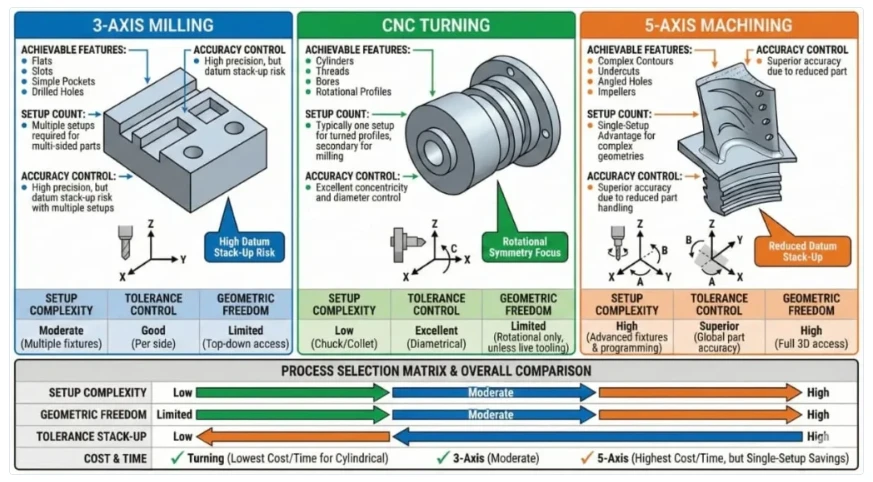
Comparison of milling, turning, and 5-axis machining processes used by CNC machining prototype service manufacturers.
| Process | Best For | Typical Tolerance |
|---|---|---|
| CNC milling | Prismatic shapes, pockets, slots | ±0.02 mm |
| CNC turning | Round parts, shafts, sleeves | ±0.015 mm |
| 5-axis CNC machining | Complex geometries, curved surfaces | ±0.025 mm |
Alloys Metal provides CNC milled parts for prototype projects requiring precise prismatic features.
Tolerances, Standards, and Drawings: What You Must Specify
Clear drawings and tolerance requirements are the foundation of a successful prototype. Ambiguous specifications lead to misalignment and rework.
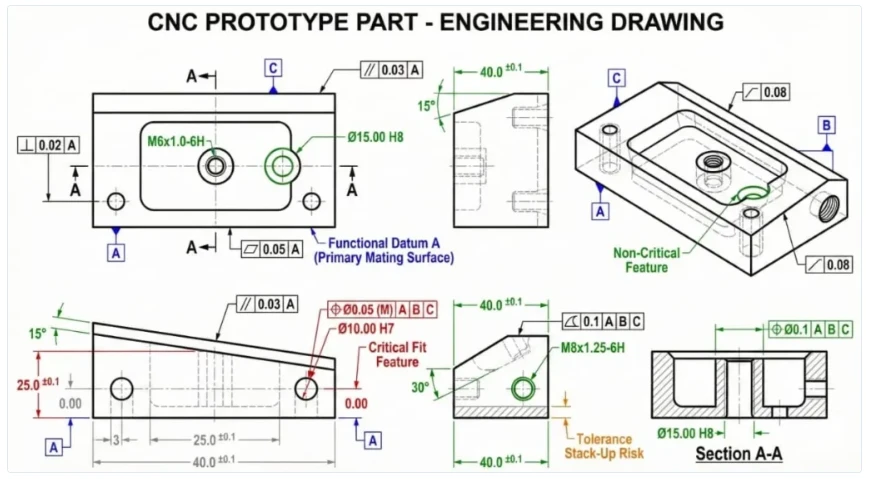
Example of GD&T, datum references, and critical features used in CNC machining prototype services to control fit and function.
GD&T and Critical Feature Definition
Use GD&T to define datum references and critical features. This gives machinists clear rules for how parts must fit and function in assemblies.
Mark only truly critical dimensions with tight tolerances. Over-specifying non-critical features drives up cost and extends lead times.
Drawing Standards and File Formats
Provide native CAD files along with PDF drawings. Include material specs, finish requirements, and any industry-specific standards.
For regulated industries, note compliance requirements upfront. This ensures inspection and documentation match your quality system.
Material Selection for CNC Machining Prototypes
Material choice directly impacts machinability, strength, weight, and cost. Select based on functional requirements, not just availability.
| Material | Key Properties | Common Prototype Use Case |
|---|---|---|
| Aluminum 6061-T6 | Good strength, lightweight, easy to machine | General industrial, electronics |
| Aluminum 7075-T6 | High strength, fatigue resistant | Aerospace, structural parts |
| Stainless Steel 304 / 316 | Corrosion resistant, durable | Medical, food equipment, marine |
| Alloy Steel | High strength, wear resistant | Industrial equipment, gears |
| Titanium (Grade 2 / 5) | High strength-to-weight, biocompatible | Aerospace, medical devices |
For lightweight, high-performance prototypes, aluminum CNC machined parts remain the most popular choice.
Copper and brass are also available for electrical and thermal applications where conductivity is critical.
Surface Finishing: Function and Appearance
Surface finishing improves both aesthetics and performance. It can enhance corrosion resistance, reduce friction, or prepare parts for coating.
Common surface finishing options include anodizing, powder coating, polishing, and passivation. Choose based on whether the prototype is for visual review or functional testing.
Alloys Metal offers a full range of CNC surface finishing services to match prototype and production requirements.
For functional prototypes, prioritize finishes that support performance goals. For display or marketing prototypes, focus on cosmetic quality.
Discuss Your Surface Finish Needs
Inspection and Quality Assurance: What to Ask For
A prototype is only useful if it matches your design. Professional services provide transparent inspection processes and clear documentation.

Quality control architecture used by professional CNC machining prototype service manufacturers, from material verification to CMM inspection.
Core Inspection Methods
Top providers use CMM inspection for dimensional verification. They also perform visual checks and material certification reviews.
First Article Inspection (FAI) is recommended for critical prototypes. It confirms every dimension matches the drawing before full prototype production proceeds.
| Inspection Item | Method | Purpose |
|---|---|---|
| Dimensional accuracy | CMM, calipers, micrometers | Verify drawing compliance |
| Material identity | Material certificates | Confirm alloy and grade |
| Surface finish | Surface roughness tester | Validate Ra values |
| Feature location | CMM with GD&T software | Check datum alignment |
Documentation Deliverables
Ask for inspection reports, material certs, and FAI records. These documents support internal reviews and regulatory compliance efforts.
For stainless steel CNC machined partsused in medical or food applications, traceable material documentation is essential.
Local vs. Global CNC Machining Prototype Services
Choosing between local and global suppliers depends on your priorities for speed, cost, and communication.
| Factor | Local Service (e.g., Georgia, Savannah) | Global Service |
|---|---|---|
| Lead Time | Faster shipping, on-site visits possible | Longer transit, faster production often |
| Cost | Higher labor and overhead | Competitive pricing |
| Communication | Same time zone, easy collaboration | Time zone differences possible |
| Quality Oversight | Easier in-person audits | Requires clear documentation |
For teams searching for cnc machining prototype service georgia or cnc machining prototype service savannah, local providers offer faster logistics and easier face-to-face reviews.
Global providers often deliver lower costs for complex parts or larger prototype batches.
Lead Times, Cost Drivers, and How to Reduce Both
Prototype lead times typically range from 3 to 15 days. Cost varies based on material, complexity, tolerances, and finish requirements.
Key cost drivers include tight tolerances, complex 5-axis work, special materials, and custom surface treatments. Heat treatment also adds time and cost.
To reduce lead time and cost:
1. Simplify geometry where possible
2. Use standard tolerances for non-critical features
3. Choose readily available materials
4. Combine multiple parts into a single order
Step-by-Step: How to Order from a CNC Machining Prototype Service
Ordering prototypes is straightforward when you prepare the right information. Follow these steps for a smooth process.
1. Prepare complete CAD files and drawing specs
2. Submit your request with material, finish, and quantity details
3. Review DFM feedback and adjust design if needed
4. Approve quote and lead time
5. Track production and inspection progress
6. Receive parts and validate against requirements
FAQ
Q: 1. What is the typical lead time for a CNC machining prototype?
A: Most simple prototypes ship in 3–7 days. Complex parts with tight tolerances or special finishes may take 10–15 days.
Q: 2. Can I get a prototype made from the same material as production parts?
A: Yes. Prototypes can be produced in production-grade materials including aluminum, stainless steel, alloy steel, and titanium.
Q: 3. Do you provide First Article Inspection for prototypes?
A: Yes. FAI is available for critical parts and recommended for aerospace, medical, and automotive prototype programs.
Q: 4. What file formats do you accept for prototype orders?
A: We accept STEP, IGES, and native CAD files from major design software. PDF drawings with dimensioned specs are also required.
Q: 5. Can you help with design for manufacturability?
A: Absolutely. DFM feedback is a standard part of our prototype service. We identify cost-saving and quality-improving adjustments early.
Q: 6. What tolerances can you hold for prototype parts?
A: Standard tolerances range from ±0.02 mm to ±0.05 mm. Tighter tolerances are available for critical features upon request.
Q: 7. Do you offer surface finishing for prototypes?
A: Yes. We provide anodizing, polishing, passivation, powder coating, and other surface finishing options.
Q: 8. Can I order just one prototype part?
A: Yes. Our prototype service supports quantities from 1 piece up to low-volume production runs.
Q: 9. What industries do you serve with prototype services?
A: We support automotive, aerospace, medical device, industrial equipment, electronics, and robotics industries.
Q: 10. How do you ensure prototype quality?
A: We use CMM inspection, material certification verification, and in-process checks. Full inspection reports are available on request.
Q: 11. Is heat treatment available for prototype parts?
A: Yes. Heat treatment can be added for alloy steel and other materials requiring enhanced strength or hardness.
Q: 12. Can you support 5-axis CNC machining for complex prototypes?
A: Yes. Our 5-axis capabilities handle complex geometries that would require multiple setups on standard machines.


