


CNC stainless steel is a broad alloy family with dramatic differences in machinability, corrosion resistance, and strength across grades. Choosing the wrong grade can raise tooling costs, extend lead times, and compromise part performance.
This guide breaks down 300-series, 400-series, and precipitation hardening (PH) stainless steels by metallurgical structure, chemical makeup, and real-world machining behavior. It helps engineers and procurement teams select the right grade for every application.

Many teams underestimate how much grade selection impacts stainless steel machinability. For example, free-machining grades run 30-50% faster than standard austenitic grades, with far less tool wear.
We combine metallurgical science with shop-floor experience to give you actionable, cost-saving insights. For custom precision parts, our team handles full material validation and process optimization.
Get a Free Material Consultation
The Austenitic Series (300 Series CNC Stainless Steel)
Austenitic stainless steels make up the largest share of CNC stainless steel production. They are non-magnetic, offer excellent corrosion resistance, and are widely used across industrial and consumer sectors.
Their high nickel and chromium content delivers durability, but also creates unique machining challenges - most notably stainless steel work hardening CNC issues. Proper feed rates and tool geometry are critical to avoid rapid tool failure.

AISI 304 / 304L Stainless Steel
AISI 304 stainless steel is the most common austenitic grade, with 18% chromium and 8% nickel. It offers good corrosion resistance, excellent formability, and reliable mechanical properties.
The low-carbon 304L variant reduces post-weld carbide precipitation, making it ideal for welded assemblies. Both grades are standard for general-purpose CNC milled parts and turned components.
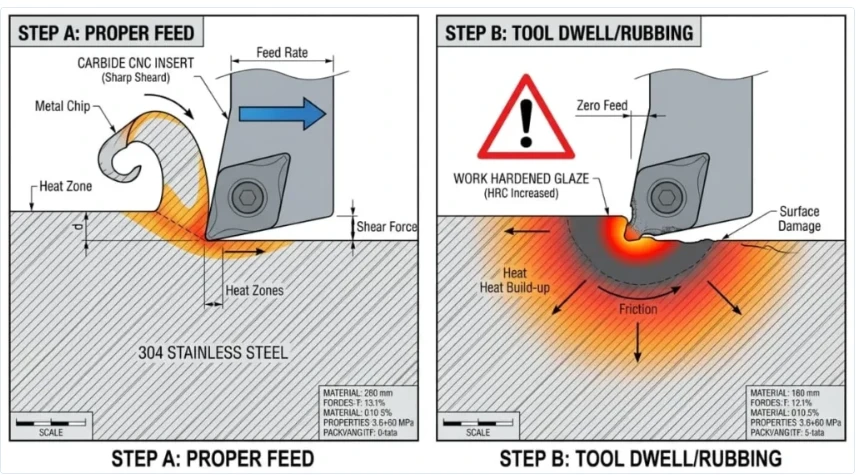
Machining 304 requires rigid setups and sharp carbide tools. Work hardening occurs quickly if the tool rubs instead of cutting, so consistent chip load is essential.
AISI 316 / 316L Stainless Steel
AISI 316 stainless steel adds 2-3% molybdenum to the 304 base formula. This upgrade boosts resistance to pitting corrosion, especially in chloride-rich environments like marine and chemical processing settings.
316L is the low-carbon version, preferred for welded CNC machined flanges and fluid handling components. It costs more than 304, but delivers critical performance in harsh service conditions.
Machining 316 is slower than 304 due to higher strength and gummy chip behavior. High-pressure coolant and positive-geometry inserts help control tool wear.
AISI 303 Stainless Steel
AISI 303 stainless steel is the free-machining variant of the 300 series. Added sulfur and manganese form manganese sulfide inclusions that break chips cleanly, reducing tool friction and cycle time.
This grade is the top choice for high-volume CNC turned parts and screw machine components. It sacrifices some corrosion resistance and formability for dramatically improved machinability.
For projects prioritizing production speed over maximum corrosion performance, 303 cuts overall part cost by 25-40% compared to 304.
Family 2: The Martensitic Series (400 Series CNC Stainless Steel)
Martensitic stainless steels are magnetic, hardenable through heat treatment, and offer high strength and wear resistance. They contain 12-18% chromium with controlled carbon levels.
These grades are popular for shafts, valves, and wear components where hardness and mechanical strength matter more than maximum corrosion resistance.
AISI 410 Stainless Steel
AISI 410 stainless steel is the basic martensitic grade, with 12% chromium and moderate carbon content. It can be hardened and tempered to achieve a range of strength and toughness profiles.
It is commonly used for CNC machined shafts and structural parts in industrial equipment. Machining is moderate in difficulty; pre-hardened bar stock may require slower feed rates.
AISI 416 Stainless Steel
AISI 416 stainless steel is the free-machining martensitic grade, with added sulfur for improved chip control. It offers the best machinability of any 400-series stainless steel.
It retains magnetic properties and can be heat treated for high hardness. This makes it ideal for precision CNC machined pins and fasteners produced in large batches.
Many engineers overlook 416 for magnetic steel projects, but it often delivers the best balance of performance and machining cost.
AISI 440C Stainless Steel
AISI 440C stainless steel is a high-carbon, high-chromium martensitic grade. It achieves the highest hardness of any common stainless steel after heat treatment, with excellent wear resistance.
It is used for CNC machined bushings, knife edges, and bearing components. Machining is more difficult due to high hardness, so most shops machine it in the annealed state before final heat treatment.
Family 3: The Ferritic Series (400 Series CNC Stainless Steel)
Ferritic stainless steels are magnetic, contain 12-30% chromium, and have very low nickel content. They offer good corrosion resistance and formability at a lower cost point than austenitic grades.
They cannot be hardened by heat treatment, and are generally easier to machine than standard austenitic grades.
AISI 430 Stainless Steel
AISI 430 stainless steel is the most widely used ferritic grade, with 17% chromium and no nickel. It provides good atmospheric corrosion resistance and is popular for decorative and structural applications.
It is a cost-effective choice for CNC machined brackets and panels where high corrosion resistance is not required. Machining is straightforward, with minimal work hardening compared to 304.
Family 4: Precipitation Hardening (PH CNC Stainless Steel)
Precipitation hardening (PH) stainless steels combine high strength, good corrosion resistance, and excellent dimensional stability after heat treatment. They are hardened by a single low-temperature aging process.
These grades are premium materials for aerospace, defense, and high-performance industrial components.
17-4 PH Stainless Steel
17-4 PH stainless steel (also called 630 stainless) is the most common PH grade. It contains 17% chromium and 4% nickel, with copper additions that form hard precipitates during aging.
It can be machined in the solution-annealed condition, then age-hardened to high strength with minimal distortion. This makes it ideal for aerospace CNC stainless steel parts and tooling components.
For complex geometries requiring tight tolerances post-heat-treatment, 17-4 PH is often the most reliable choice.
15-5 PH Stainless Steel
15-5 PH stainless steel is a modified version of 17-4 PH with higher toughness and better transverse properties. It is used for structural components where uniform strength in all directions is critical.
Machining behavior is similar to 17-4 PH, with good chip control and moderate tool wear. It is commonly specified for medical CNC stainless steel components and high-stress industrial parts.
Quick Reference: The Machinist's Cheat Sheet
This table summarizes key properties of common CNC stainless steel grades for fast comparison. Use it as a starting point for initial material selection.
| Grade | Series | Magnetism | Machinability Rating (1=hard, 10=easy) | Primary Applications |
|---|---|---|---|---|
| 304/304L | Austenitic (300) | Non-magnetic | 4 | General industrial parts, food equipment |
| 316/316L | Austenitic (300) | Non-magnetic | 3 | Marine, chemical processing, medical |
| 303 | Austenitic (300) | Non-magnetic | 7 | High-volume turned parts, fasteners |
| 410 | Martensitic (400) | Magnetic | 5 | Shafts, valves, structural parts |
| 416 | Martensitic (400) | Magnetic | 8 | Precision pins, screws, machined fasteners |
| 440C | Martensitic (400) | Magnetic | 2 | Bearings, wear components, cutting tools |
| 430 | Ferritic (400) | Magnetic | 6 | Brackets, panels, decorative parts |
| 17-4 PH | PH | Magnetic | 5 | Aerospace, tooling, high-strength components |
| 15-5 PH | PH | Magnetic | 5 | Medical devices, structural aerospace parts |
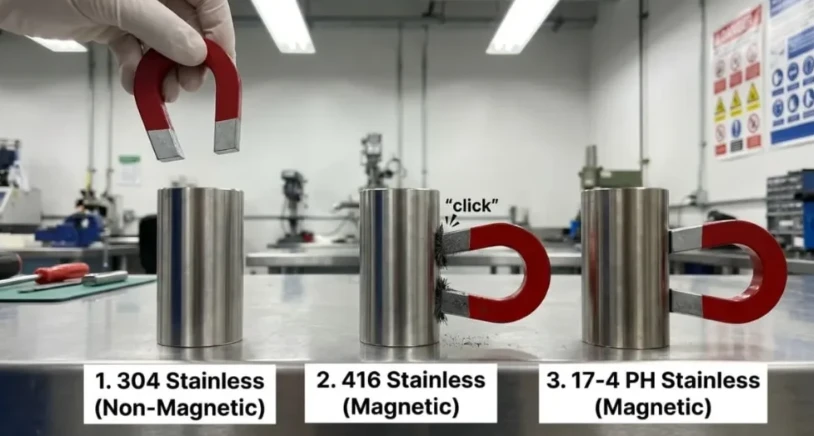
A quick magnet test can help distinguish grade families on the shop floor, but always verify with material certification for critical applications.
If you need help narrowing down grade options for your specific project, our engineering team provides free material selection support.
Expert Advice: The 416 Secret Weapon
After decades of machining stainless steel, our shop floor team consistently recommends AISI 416 stainless steel for projects needing magnetic, hardenable, and cost-effective steel parts.
Most engineers default to 304 or 316 without considering 416, even when corrosion requirements are moderate and magnetic properties are acceptable. Switching to 416 can cut machining time by 30% or more.
It machines nearly as fast as free-machining carbon steel, but offers the corrosion benefit of 12% chromium. For CNC machined fittings, connectors, and small precision components, it is often the best value choice.
Always confirm corrosion requirements with your engineering team before switching grades. For mildly corrosive indoor or protected environments, 416 usually performs perfectly.
If you have a current 304 or 410 part that you want to optimize for cost, send us the drawing and we will evaluate if 416 is a viable alternative.
Conclusion: Specificity Saves Money
The biggest mistake in CNC stainless steel sourcing is specifying "stainless steel" without a clear grade. Vague material calls lead to wrong material selection, higher machining costs, and potential part failure.
By matching grade properties to your actual performance requirements - corrosion resistance, strength, magnetism, and machinability - you can reduce part cost significantly without sacrificing quality.
Our team at alloys-metal.com specializes in precision stainless steel CNC machined parts across all major grades. We provide DFM feedback, material certification, and full quality inspection for every order.
Whether you need prototypes or production volumes, we help you select the right grade and optimize machining processes for maximum value.
For projects requiring high precision and complex geometries, our 5 axis CNC machined parts capabilities deliver tight tolerances on even the most intricate stainless steel components.
Submit Your Drawing for a Quote
FAQ
Q: 1. What is the easiest stainless steel to machine with CNC?
A: AISI 416 stainless steel is generally the easiest common grade to CNC machine, thanks to its free-machining sulfur additions. It produces short, broken chips and causes minimal tool wear. For non-magnetic applications, AISI 303 is the top free-machining choice.
Q: 2. What is the difference between 304 and 316 stainless steel?
A: AISI 316 stainless steel contains 2-3% molybdenum, which gives it better resistance to pitting and chloride corrosion than 304. 316 is preferred for marine, chemical, and medical applications, while 304 is the standard for general-purpose use. 316 is also more expensive and slightly harder to machine.
Q: 3. Is 17-4 PH stainless steel magnetic?
A: Yes, 17-4 PH stainless steel is magnetic in both the annealed and age-hardened conditions. It is a precipitation hardening grade that combines high strength with good corrosion resistance, making it popular for aerospace and industrial tooling applications.
Q: 4. What causes work hardening in CNC stainless steel machining?
A: Work hardening occurs when the cutting tool rubs against the workpiece instead of making a clean cut. The plastic deformation of the surface layer increases hardness, which accelerates tool wear. Proper feed rates, sharp tools, and rigid setups help minimize this effect, especially with austenitic grades like 304.
Q: 5. Can you CNC machine 440C stainless steel?
A: Yes, 440C can be CNC machined, but it is typically machined in the annealed (soft) condition first. After machining, the part is heat treated to achieve high hardness. Machining fully hardened 440C requires special tooling and slower feed rates, so most shops follow the machine-then-harden sequence.
Q: 6. What is the cheapest stainless steel for CNC parts?
A: AISI 430 stainless steel is generally the lowest-cost common grade, due to its lack of nickel content. It is a ferritic grade with good atmospheric corrosion resistance, suitable for brackets, panels, and non-critical structural parts.
Q: 7. Is 303 stainless steel less corrosion resistant than 304?
A: Yes, 303 has slightly lower corrosion resistance than 304 because of its sulfur additions for free machining. It is still suitable for most indoor and mild outdoor applications, but not recommended for highly corrosive environments like saltwater exposure.
Q: 8. What is precipitation hardening in stainless steel?
A: Precipitation hardening is a heat treatment process where fine alloy precipitates form within the metal structure, increasing strength and hardness. PH grades like 17-4 PH are machined in a soft state, then aged at low temperature to harden with minimal dimensional distortion.
Q: 9. How do I choose between austenitic and martensitic stainless steel?
A: Choose austenitic grades (304, 316) for maximum corrosion resistance and non-magnetic properties. Choose martensitic grades (410, 416, 440C) when you need magnetic properties, high hardness, or better wear resistance, and corrosion requirements are moderate.
Q: 10. Does CNC stainless steel cost more than aluminum?
A: Yes, CNC stainless steel parts typically cost more than aluminum parts. Stainless steel has higher material cost, slower machining speeds, and greater tool wear. However, it offers higher strength, better corrosion resistance, and higher temperature tolerance for demanding applications.
Q: 11. What surface finish options are available for CNC stainless steel parts?
A: Common finishes include as-machined, bead blasted, brushed, polished, and passivated. Passivation is especially important for stainless steel, as it removes free iron from the surface and enhances corrosion resistance.
Q: 12. Can you hold tight tolerances on CNC stainless steel parts?
A: Yes, with proper tooling, rigid machine setups, and process control, tight tolerances can be consistently held on stainless steel parts. Tolerances depend on part geometry, size, and the specific machining process used.


