


Carbon steel is the most widely used material in CNC machining for industrial parts, thanks to its balanced strength, cost efficiency, and broad compatibility with fabrication processes.
Choosing the wrong carbon steel grade can lead to poor machinability, unexpected tool wear, missed tolerance targets, or even part failure in end use.
This guide breaks down 5 core categories of CNC carbon steel, their key grades, machining behavior, and ideal applications to help engineers and procurement teams make faster, more accurate material selections.
Carbon Structural Steel: The Economy Choice (1018 / A36)
Carbon structural steel is the entry-level, high-volume option for general-purpose CNC parts, with low carbon content that delivers excellent formability and weldability.
Core Grade: AISI 1018 Steel
AISI 1018 steel contains 0.18% carbon, with minimal alloying elements, making it one of the most affordable carbon steel grades on the market.
It offers good ductility and impact resistance, though its tensile strength is lower than higher-carbon variants.
Machinability and Use Cases
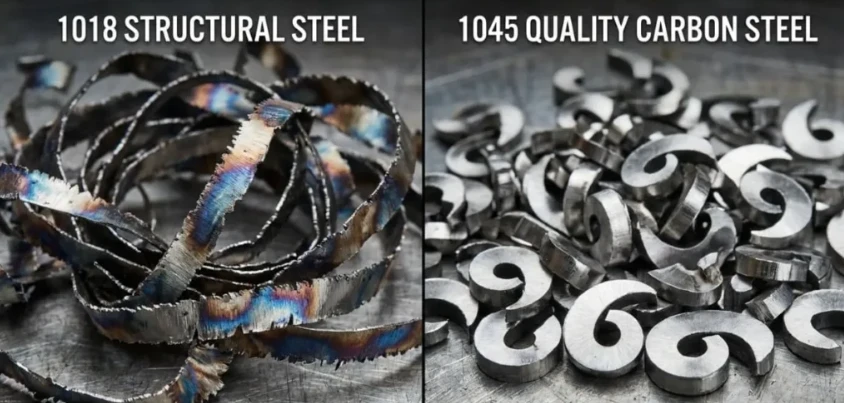
The carbon steel machinability rating of 1018 is moderate: its low hardness reduces tool wear, but it produces long, stringy chips that can slow cycle times if chip breakers are not used.
It is ideal for non-load-bearing brackets, spacers, and general structural components where cost is a top priority.
For low-volume prototype builds, 1018 pairs well with CNC prototyping service workflows to keep material and machining costs low.
Request a 1018 Steel CNC Quote
Quality Carbon Structural Steel: The Precision Standard (1045)
Quality carbon structural steel sits above basic structural grades, with tighter chemical composition controls and improved mechanical consistency for precision parts.
Core Grade: AISI 1045 Steel
AISI 1045 steel has 0.45% carbon, delivering significantly higher tensile strength and hardness than 1018, with good wear resistance after heat treatment.
Its uniform composition reduces material variation, making it reliable for tight-tolerance machining runs.
Machining Performance and Applications
1045 produces short, broken C-shaped chips during cutting, which improves CNC machining chip formation control and reduces downtime for chip clearing.
It is the go-to choice for carbon steel for CNC shafts, gears, and fasteners that require balanced strength and dimensional accuracy.
Many CNC machined shafts for industrial equipment are manufactured from 1045 due to its predictable machining response and post-processing hardening capability.
Get a 1045 Precision Part Quote
Free-Cutting Carbon Steel: The Speed Demon (12L14)
Free-cutting carbon steel is formulated specifically to maximize machining speed and surface finish, making it ideal for high-volume production runs.
Core Grade: AISI 12L14 Free-Cutting Steel
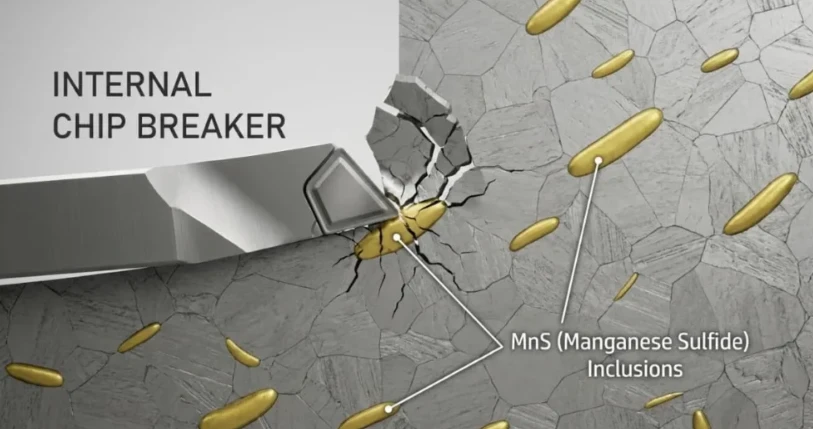
AISI 12L14 free-cutting steel contains lead and manganese sulfide inclusions that act as natural chip breakers during cutting.
These inclusions reduce friction between the tool and workpiece, allowing for faster feed rates and longer tool life.
Advantages, Limitations, and Use Cases
The biggest advantage of 12L14 is its 30-40% faster machining speed compared to 1018, with superior carbon steel surface finish right off the machine.
Its main limitation is reduced weldability and lower impact strength, so it is not suitable for structural or high-load parts.
It is the top choice for carbon steel for mass production CNC parts like connectors, pins, and small precision components where cycle time directly impacts cost.
For high-volume turned components, 12L14 is often paired with Swiss CNC Machining to achieve ultra-tight tolerances at high speed.
Alloy Structural Steel: The Heavy Duty Option (4140 / 8620)
Alloy structural steel adds elements like chromium, molybdenum, and nickel to basic carbon steel, boosting strength, toughness, and hardenability for high-stress applications.

Core Grade: AISI 4140 Alloy Steel
AISI 4140 alloy steel is a chromium-molybdenum grade with excellent tensile strength, fatigue resistance, and through-hardening capability.
It maintains good machinability in its annealed state, and can be heat treated to reach high hardness for demanding load conditions.
It is widely used for hydraulic components, gear shafts, and high-strength fasteners in heavy industrial equipment.
Carburizing Grade: AISI 8620 Carburizing Steel
AISI 8620 carburizing steel is a low-alloy grade designed for case hardening, producing a hard, wear-resistant outer surface while retaining a tough, shock-resistant inner core.

It is the preferred choice for transmission gears, camshafts, and other parts that require surface wear resistance plus core toughness.
Discuss High-Strength Alloy Steel Parts
Carbon Tool Steel: Extreme Hardness (O1 / D2)
Carbon tool steel is a high-carbon, high-alloy category designed for maximum hardness and wear resistance, used primarily for cutting tools, dies, and wear components.
AISI O1 Tool Steel
AISI O1 tool steel is an oil-hardening grade with good machinability in its annealed state, and it achieves high hardness after heat treatment.
It is commonly used for blanking dies, cutting blades, and precision gauge parts.
AISI D2 Tool Steel
AISI D2 tool steel is a high-chromium, high-carbon grade with exceptional wear resistance and dimensional stability during hardening.
It is more difficult to machine than O1, but it delivers far longer service life for high-wear tooling applications.
Note that tool steel parts require careful machining parameter adjustment to avoid excessive tool wear and surface damage.
Visualizing Carbon Steel Properties
The difference in machinability across carbon steel grades becomes clear when comparing chip formation and microstructure directly.
Chip Formation Comparison
Low-carbon grades like 1018 produce long, continuous, heat-tinted blue chips that can wrap around tooling and cause surface defects.
Higher-carbon or free-cutting grades like 1045 produce short, clean, silver C-shaped chips that evacuate easily, reducing downtime and improving finish.
Microstructure Explanation
Free-cutting steels like 12L14 have dispersed lead and sulfur inclusions that act as internal chip breakers, fracturing chips as the cutting tool passes through the material.
This microstructure is what enables faster cutting speeds and better surface finish without sacrificing dimensional accuracy.
Summary Matrix: Choosing the Right Carbon Steel
Use the table below to compare key attributes of common CNC carbon steel grades at a glance:
| Steel Grade | Category | Machinability (1-10, 10=best) | Tensile Strength | Best For |
|---|---|---|---|---|
| AISI 1018 | Carbon structural steel | 7 | Low | General structural parts, low-cost prototypes |
| AISI 1045 | Quality carbon structural steel | 6 | Medium | Shafts, gears, precision components |
| AISI 12L14 | Free-cutting carbon steel | 10 | Low-Medium | High-volume small parts, fast production |
| AISI 4140 | Alloy structural steel | 5 | High | Heavy-duty shafts, hydraulic parts |
| AISI 8620 | Alloy structural steel | 6 | Medium-High | Case-hardened gears, transmission parts |
| AISI O1 | Carbon tool steel | 4 | Very High | Cutting tools, dies, gauges |
| AISI D2 | Carbon tool steel | 3 | Extremely High | High-wear tooling, long-life dies |
Expert Tip: Don't Forget the Finish
Carbon steel is prone to rust, so specifying the right surface finish is critical for long-term part performance, especially for outdoor or moisture-exposed applications.
Common CNC surface finishing services for carbon steel include zinc plating, black oxide, powder coating, and clear lacquer, each offering different levels of corrosion protection and cosmetic appearance.
For high-wear parts, hard chrome plating or nitriding can also be applied to boost surface hardness alongside corrosion resistance.
Get Surface Finish Recommendations
FAQ
Q: What is CNC carbon steel?
A: CNC carbon steel is a category of iron-carbon alloys specifically processed using CNC machining equipment, with carbon content ranging from under 0.1% to over 1%, tailored for different strength and machinability requirements.
Q: What is the easiest carbon steel to machine?
A: AISI 12L14 free-cutting steel has the highest machinability rating among common carbon steel grades, thanks to lead and sulfur inclusions that improve chip breaking and reduce cutting friction.
Q: What is the difference between 1018 and 1045 steel?
A: 1018 is a low-carbon structural steel with lower strength, lower cost, and stringier chip formation, while 1045 is a medium-carbon quality structural steel with higher strength, better chip control, and suitability for load-bearing parts.
Q: Is 4140 steel harder than 1045?
A: In their annealed states, 4140 and 1045 have similar initial hardness, but 4140 can achieve significantly higher hardness and strength after heat treatment due to its chromium and molybdenum alloy content.
Q: What is 12L14 steel used for?
A: 12L14 is used for high-volume, precision small parts like connectors, pins, bushings, and fasteners where fast machining speeds and good surface finish are prioritized over high strength or weldability.
Q: Can carbon steel be used for CNC shafts?
A: Yes, medium-carbon and alloy carbon steels like 1045 and 4140 are the most common materials for CNC machined shafts, offering balanced strength, wear resistance, and machinability.
Q: What is the best carbon steel for mass production?
A: AISI 12L14 free-cutting steel is the top choice for mass production CNC parts, as it reduces cycle times by 30-40% compared to standard carbon steel grades.
Q: How does carbon content affect machinability?
A: Lower carbon content generally produces softer, more ductile steel that creates long, stringy chips, while medium carbon content improves chip breaking; very high carbon content increases hardness and tool wear.
Q: What surface finishes work for carbon steel parts?
A: Common finishes for carbon steel include zinc plating, black oxide, powder coating, nitriding, and hard chrome plating, selected based on corrosion resistance, wear resistance, and cosmetic requirements.
Q: What is the cheapest carbon steel for CNC machining?
A: AISI 1018 is the most cost-effective carbon steel grade for general-purpose CNC parts, making it popular for prototypes and low-stress structural components.
Q: Is carbon tool steel difficult to machine?
A: Carbon tool steels like O1 and D2 are more challenging to machine than structural grades, especially in their hardened state, requiring slower feed rates and specialized cutting tools.
Q: What is 8620 steel used for?
A: AISI 8620 carburizing steel is used for parts that require a hard wear-resistant surface and a tough inner core, such as transmission gears, camshafts, and automotive drivetrain components.


