


If you have ever struggled with 3-axis machining limitations when producing complex curved parts, you know the frustration of multiple setups, tolerance stack-up, and extended lead times.
Many procurement teams and engineers still assume 5-axis CNC machining is only for aerospace projects with unlimited budgets. That is a costly misconception.
This guide breaks down the core process, cost logic, machine types, and design rules of 5-axis machining to help you make informed sourcing decisions.
What Exactly is 5-Axis CNC Machining?

Basic Definition and Axis Composition
5-axis CNC machining uses five independent axes of motion to cut metal parts with high precision.
Traditional 3-axis machines move along X, Y, and Z linear axes. 5-axis systems add two rotary axes, typically labeled A and C, to rotate the part or tool head.
This full range of motion lets the cutter access nearly every surface of a workpiece in a single setup.
Core Working Principle
The machine controller synchronizes all five axes to maintain optimal cutting tool engagement with the workpiece surface.
Unlike 3-axis machining, which often requires re-fixturing parts to reach angled features, 5-axis systems adjust orientation continuously during cutting.
The result is faster production of complex geometries with fewer manual handling steps.
Machine Architectures: Trunnion vs. Swivel Head
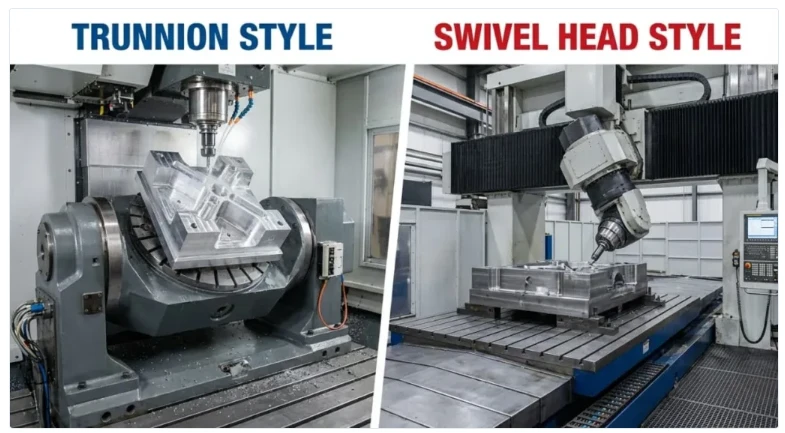
Trunnion Style 5-Axis Machine
A trunnion style 5-axis machine rotates the workpiece using a tilting rotary table mounted on the machine bed.
This design keeps the cutting spindle rigid and stable, making it ideal for heavy or bulky parts.
It is widely used for mid-sized precision components in aerospace and medical industries.
Swivel Head Style 5-Axis Machine
A swivel head style 5-axis machine rotates the cutting spindle instead of the workpiece table.
This architecture works well for large, heavy parts that are difficult to rotate at high speeds.
It also supports longer tool reach for deep cavity features in structural components.
| Machine Type | Key Advantage | Best For | Typical Part Size |
|---|---|---|---|
| Trunnion style | Higher spindle rigidity, better surface finish | Small to medium complex parts | Up to medium work envelopes |
| Swivel head style | Handles heavy workpieces, deep cavity access | Large structural components | Large work envelopes |
The Critical Distinction: Simultaneous vs. 3+2

3+2 Axis CNC Machining
3+2 axis CNC machining, also called positional 5-axis machining, locks the rotary axes at fixed angles during cutting.
The machine uses standard 3-axis motion while the part is tilted to a specific orientation.
It is cost-effective for angled holes, chamfers, and multi-face parts that do not need continuous contouring.
Simultaneous 5-Axis CNC Machining
Simultaneous 5-axis CNC machining moves all five axes continuously throughout the cut.
This mode produces smooth, complex 3D surfaces such as turbine blades and organic medical implant shapes.
It requires advanced CAM programming and tighter machine calibration but delivers unmatched geometric accuracy.
| Machining Mode | Setup Complexity | Best Application | Cost Level |
|---|---|---|---|
| 3+2 axis | Low to medium | Angled features, multi-face parts | Moderate |
| Simultaneous 5-axis | High | Complex curved surfaces, impellers | Higher per-hour |
The "Hidden" Engineering Benefits

Improved Accuracy and Tolerance Control
Done-in-One machining eliminates re-fixturing steps, reducing tolerance stack-up between operations.
GD&T tolerance control becomes more predictable because all features are machined from a single setup reference.
This is critical for safety-critical parts in aerospace and medical device sectors.
Better Surface Finish
5-axis machining lets you use shorter, stiffer cutting tools that deflect less under load.
Scallop height control is easier to maintain because the tool can stay normal to curved surfaces across the entire cut.
The result is less manual polishing and more consistent surface quality across complex contours.
Faster Cycle Times for Complex Parts
Even though 5-axis machine hourly rates are higher, single-setup production often reduces total cycle time.
You save hours of fixturing, part flipping, and in-process inspection that add up on 3-axis jobs.
For parts with five or more machined faces, the time savings can be dramatic.
The Economics: Is 5-Axis CNC Machining Worth the Cost?
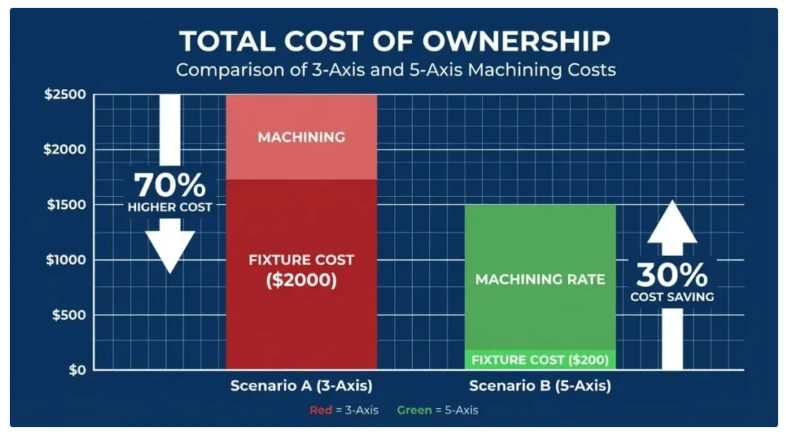
Many buyers assume 5-axis machining is always more expensive than 3-axis. That is only true for simple, flat parts.
For complex geometries, the total production cost often drops because you eliminate multiple setups, reduce scrap, and shorten lead times.
Aerospace brackets, for example, may require six setups on a 3-axis machine but only one on a 5-axis system.
| Cost Factor | 3-Axis Machining | 5-Axis Machining |
|---|---|---|
| Hourly machine rate | Lower | Higher |
| Number of setups | Multiple | One (done-in-one) |
| Labor for fixturing | High | Low |
| Tolerance stack-up risk | Higher | Lower |
| Total cost for complex parts | Higher | Lower |
If your part has undercuts, compound angles, or curved surfaces, 5-axis machining almost always delivers better total value.
For simple prismatic parts with only two or three machined faces, 3-axis remains the more economical choice.
Get a Custom 5-Axis Cost Quote
DFM Guide: Designing for 5-Axis Success
DFM for 5-axis machining helps you avoid costly design mistakes and maximize the advantages of the technology.
Follow these core guidelines to ensure your parts are machinable, accurate, and cost-effective.
Minimize Deep, Narrow Cavities
Even with 5-axis access, very deep narrow pockets require long thin tools that cause vibration.
Keep cavity depth-to-width ratios under 4:1 whenever possible for best surface finish and tool life.
Allow Tool Access to All Features
Avoid undercuts that require special lollipop cutters or extended reach holders unless absolutely necessary.
If undercuts are required, specify their exact dimensions early so the machining team can plan tooling accordingly.
Use Consistent Draft Angles
Uniform draft angles on side walls help the tool maintain constant engagement and reduce scallop height variation.
A 1 to 3 degree draft is usually sufficient for most metal components.
Specify Realistic Tolerances
Tighter tolerances increase machining time and cost significantly.
Apply the tightest tolerances only to functional surfaces, and use standard tolerances for non-critical features.
For more general DFM best practices across all precision part types, review our guide to CNC precision machining parts.
Industry Applications: Who Needs This Technology?

5-axis machining serves a wide range of industries that demand complex geometries and tight tolerances.
Below are the most common use cases where the technology delivers clear competitive advantage.
| Industry | Typical Parts | Key Value of 5-Axis |
|---|---|---|
| Aerospace | Turbine blades, structural brackets, impellers | High accuracy, reduced weight, aerospace machined parts compliance |
| Medical | Orthopedic implants, surgical instruments | Biocompatible material precision, smooth curved surfaces |
| Automotive | Intake manifolds, transmission housings | Complex internal passages, reduced assembly parts |
| Industrial | Pump housings, valve bodies, tooling components | Single-setup accuracy, faster production |
Impeller machining is one of the most demanding 5-axis applications, requiring simultaneous motion to produce precise blade profiles.
Medical implants machining relies on 5-axis for custom-fit geometries that match patient anatomy perfectly.
Automotive manifold machining benefits from 5-axis by reducing leak points and improving fluid flow characteristics.
For aerospace-specific requirements and material selection, explore our dedicated aerospace CNC machined parts resource page.
Summary: The CNMP Advantage
5-axis CNC machining is no longer a niche technology reserved for ultra-high-budget aerospace programs.
From medical implants to automotive manifolds, it delivers better accuracy, faster lead times, and lower total cost for complex metal parts.
The key is choosing the right machine architecture, machining mode, and DFM strategy for your specific part geometry.
Alloys Metal offers full-spectrum 5 axis CNC machined parts production, from prototyping to high-volume manufacturing.
Our engineering team supports DFM optimization, GD&T compliance, and material selection for all seven of our standard metal materials.
We combine advanced 5-axis equipment with rigorous inspection processes to deliver consistent quality on every order.
To learn more about our full 5-axis production capabilities, visit our main 5 axis CNC machined parts service page.
Start Your 5-Axis Project Today
FAQ
Q: What is the main difference between 3-axis and 5-axis CNC machining?
A: 3-axis machining moves the cutting tool along X, Y, and Z linear axes only. 5-axis machining adds two rotary axes, allowing the tool or part to rotate and access multiple part surfaces in a single setup.
Q: Is 5-axis machining always more expensive than 3-axis?
A: No. For simple flat parts, 3-axis is usually cheaper. For complex parts with multiple angled features or curved surfaces, 5-axis often costs less overall because it eliminates multiple setups and reduces labor time.
Q: What is the difference between 3+2 axis and simultaneous 5-axis machining?
A: 3+2 axis machining tilts the part to a fixed angle and then cuts using standard 3-axis motion. Simultaneous 5-axis machining moves all five axes continuously during cutting, making it suitable for complex 3D curved surfaces.
Q: What materials can be machined with 5-axis CNC?
A: 5-axis machines work with all common industrial metals, including titanium, stainless steel, aluminum, copper, brass, alloy steel, and carbon steel. Material choice depends on part function, strength requirements, and budget.
Q: What is a trunnion style 5-axis machine best used for?
A: Trunnion style machines rotate the workpiece on a tilting table. They offer high spindle rigidity and are ideal for small to medium-sized complex parts that require excellent surface finish and tight tolerances.
Q: What industries benefit most from 5-axis machining?
A: Aerospace, medical, automotive, and industrial equipment industries benefit the most. Common applications include impellers, medical implants, automotive manifolds, and structural aerospace components.
Q: How does 5-axis machining improve part accuracy?
A: By machining all features in a single setup, 5-axis eliminates tolerance stack-up caused by re-fixturing. This results in more consistent GD&T compliance and fewer alignment errors between features.
Q: What is done-in-one machining?
A: Done-in-one machining means completing all milling, drilling, and tapping operations on a part in a single machine setup. 5-axis technology enables done-in-one production for most complex geometries.
Q: What design mistakes should I avoid for 5-axis machining?
A: Avoid extremely deep narrow cavities, undercuts with no tool access, and unnecessarily tight tolerances on non-critical features. Good DFM practice reduces cost and improves part quality.
Q: Can 5-axis machining be used for prototyping?
A: Yes. 5-axis machining is excellent for functional prototypes of complex parts, especially in aerospace and medical fields where design validation requires high accuracy and production-like material properties.
Q: How does scallop height control work in 5-axis machining?
A: Scallop height refers to the small ridges left between adjacent cutting paths. In 5-axis machining, the tool can stay perpendicular to curved surfaces, reducing scallop height and improving surface finish consistency.
Q: What is the typical lead time for 5-axis machined parts?
A: Lead time depends on part complexity, material, and batch size. Prototype parts can often be completed in a few days, while production runs may take a few weeks. Your supplier can provide a precise timeline after reviewing your drawings.


