


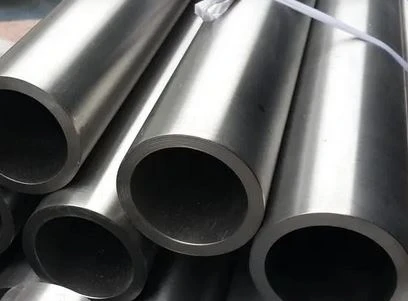

Ti Alloy Grade 12 Pipes And Tubes
Excellent Cold Formability
Excellent Weldability
Excellent Resistance to High Oxidation
What is Titanium Grade 12?
Grade 12 titanium (Ti-0.3Mo-0.8Ni) offers significantly enhanced corrosion resistance compared to commercially available pure titanium, while maintaining excellent machinability and moderate strength. This alloy was developed to bridge the performance gap between pure titanium and more expensive corrosion-resistant alloys such as Grade 7 titanium.
By adding molybdenum and nickel, Grade 12 titanium exhibits superior resistance to reducing acids, crevice corrosion, and high-temperature chloride environments, making it ideal for chemical equipment, heat exchangers, and components exposed to corrosive media where pure titanium's performance is already at its limit.
Chemical Composition (ASTM B861 / ASTM B338)
| Element | Composition Range (%) | Role in Alloy |
|---|---|---|
| Molybdenum | 0.2 – 0.4 | Enhances reducing acid resistance |
| Nickel | 0.6 – 0.9 | Improves crevice corrosion resistance |
| Iron (max) | 0.3 | Impurity control |
| Oxygen (max) | 0.25 | Affects strength and ductility |
| Carbon (max) | 0.08 | Maintains purity |
| Nitrogen (max) | 0.03 | Controlled for properties |
| Hydrogen (max) | 0.015 | Prevents hydride embrittlement |
| Titanium | Balance | Base material |
Key Properties of Titanium Grade 12
Mechanical Properties (Annealed Condition)
| Property | Value | Comparison to Grade 2 |
|---|---|---|
| Tensile Strength (min) | 485 MPa (70 ksi) | 40% stronger |
| Yield Strength (min) | 345 MPa (50 ksi) | 25% stronger |
| Elongation (min) | 18% | Slightly lower |
| Reduction of Area (min) | 25% | Slightly lower |
| Hardness (typical) | 90-100 HRB | Higher |
| Modulus of Elasticity | 103 GPa (15 × 10⁶ psi) | Identical |
Physical Properties
| Property | Value |
|---|---|
| Density | 4.51 g/cm³ (0.163 lb/in³) |
| Melting Point | 1668°C (3034°F) |
| Thermal Conductivity | 19 W/m·K at 20°C |
| Coefficient of Thermal Expansion | 8.8 µm/m·°C (20-100°C) |
| Electrical Resistivity | 0.52 µΩ·m |
| Magnetic Properties | Non-magnetic |
| Specific Heat | 0.540 J/g·°C |
Grade 12 vs Other Titanium Grades
| Property | Grade 2 | Grade 5 | Grade 7 | Grade 12 |
|---|---|---|---|---|
| Tensile Strength (MPa) | 345 | 895 | 345 | 485 |
| Yield Strength (MPa) | 275 | 825 | 275 | 345 |
| Elongation (%) | 20 | 10 | 20 | 18 |
| Formability | Excellent | Fair | Excellent | Very Good |
| Weldability | Excellent | Good | Excellent | Excellent |
| Reducing Acid Resistance | Fair | Fair | Excellent | Good-Excellent |
| Crevice Corrosion Resistance | Good | Good | Excellent | Excellent |
| Relative Cost | Low | Moderate | High | Moderate |
Key Advantages of Grade 12:
Enhanced reducing acid resistance – Better than Grade 2
Superior crevice corrosion resistance – Approaches Grade 7
Higher strength – 40% stronger than Grade 2
Excellent fabricability – Similar to Grade 2
Good weldability – No post-weld heat treatment required
Cost-effective alternative – Lower cost than Grade 7
Non-magnetic – For sensitive applications
Standard Tube Sizes (Heat Exchanger - ASTM B338)
| OD (mm) | Wall Thickness (mm) | Typical Applications |
|---|---|---|
| 12.7 mm (1/2") | 0.5 – 1.2 mm | Small heat exchangers |
| 15.9 mm (5/8") | 0.7 – 1.6 mm | General service |
| 19.1 mm (3/4") | 0.7 – 1.6 mm | Most common size |
| 25.4 mm (1") | 0.9 – 2.0 mm | Large heat exchangers |
| 31.8 mm (1-1/4") | 1.2 – 2.5 mm | Special applications |
| 38.1 mm (1-1/2") | 1.2 – 3.0 mm | Process heaters |
| 50.8 mm (2") | 1.6 – 4.0 mm | Large-diameter tubes |
FAQ
Q1: What is the main advantage of Grade 12 over Grade 2?
Grade 12 offers enhanced corrosion resistance in reducing acids (HCl, H₂SO₄) and superior crevice corrosion resistance, plus 40% higher strength-all while maintaining excellent fabricability.
Q2: How does Grade 12 compare to Grade 7?
Grade 7 offers slightly better reducing acid resistance (due to palladium)
Grade 12 offers higher strength and lower cost
Both have excellent crevice corrosion resistance
Grade 12 is often selected when strength matters and cost is a consideration
Q3: Is Grade 12 suitable for seawater service?
Excellent. Grade 12 performs exceptionally well in seawater, with even better crevice corrosion resistance than Grade 2 in stagnant or low-flow conditions.
Q4: Can Grade 12 be used at elevated temperatures?
Yes, Grade 12 maintains good mechanical properties up to 300°C (570°F) and has been used successfully in high-temperature brine applications.
Q5: Does Grade 12 require special welding procedures?
No-Grade 12 welds similarly to Grade 2. Standard titanium welding practices with ERTi-12 filler metal and proper inert gas shielding produce high-quality welds.
Our Manufacturing Facility
Our factory is a specialized titanium manufacturing facility equipped with advanced production machinery including vacuum arc remelting (VAR) furnaces for high-purity ingot melting, hydraulic forging presses and rotary piercing mills for tube hollow production, pilger mills and cold drawing benches for precision pipe and tube forming, vacuum and atmosphere-controlled annealing furnaces for heat treatment, and complete finishing lines for cutting, straightening, and surface processing. Our in-house quality laboratory features optical emission spectrometers (OES) for chemical analysis, universal testing machines (UTM) for mechanical properties, ultrasonic flaw detectors and eddy current testers for non-destructive inspection, metallographic microscopes for microstructure evaluation, and hydrostatic testers for pressure integrity verification-ensuring every pipe and tube meets strict international standards before shipment.

Hot Tags: ti alloy grade 12 pipes and tubes, China ti alloy grade 12 pipes and tubes manufacturers, suppliers, factory, titanium, titanium pipe export regulations, titanium pipe economic sanctions, titanium pipe packaging, Gr9 Titanium Straight Piping, 3 inch titanium pipe, titanium pipe creep resistance
You Might Also Like


Send Inquiry