


If you only list an aluminum grade on your CNC machining drawing, you are missing half the specification. The same alloy can deliver drastically different strength, ductility, and CNC machinability depending on its temper condition.
This guide breaks down common CNC aluminum alloy grades, the aluminum temper system, and how each combination performs in real machining workflows. It helps engineers and procurement teams select the right material to avoid tool wear, dimensional drift, and part failure.
For a full overview of our material capabilities, explore our aluminum CNC machined parts page.
The "Secret Code" of CNC Aluminum Alloy Tempers
Aluminum alloys fall into two core groups: heat treatable aluminum alloys and non-heat treatable aluminum alloys. Heat treatable grades gain strength through solution heat treatment and quenching, while non-heat treatable grades rely on cold work or alloying alone.
The three most common temper designations for CNC work are O, T, and H. Each changes grain structure, chip formation, and final part performance.
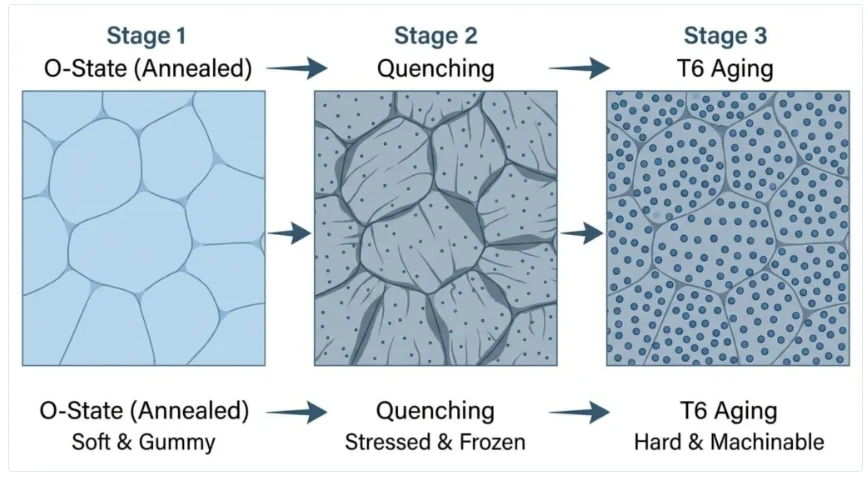
O Temper (Annealed)
O temper aluminum is fully annealed, soft, and highly ductile. It forms easily but produces long, gummy chips during milling.
It is rarely chosen for high-precision structural CNC parts, but works well for deep-drawn or formed components that receive secondary bending.
T Temper (Thermally Treated)
T tempers apply to heat treatable alloys. The most widely used in CNC shops is 6061-T6, which offers a strong balance of strength, corrosion resistance, and machinability.
Stress relieved tempers such as 6061-T651 add a stretching step after quenching to reduce internal stress, making them ideal for tight-tolerance plates and large structural parts.
H Temper (Strain Hardened)
H tempers apply to non-heat treatable alloys. They gain strength through cold working, sometimes followed by partial annealing.
A common example is 5052-H32, which offers good corrosion resistance and moderate strength for sheet metal and light structural components.
The table below summarizes key temper performance for CNC manufacturing:
| Temper Type | Core Process | Typical Grade Example | CNC Machinability | Best Use Case |
|---|---|---|---|---|
| O | Full annealing | 6061-O | Low (gummy chips) | Formed, bent, or deep-drawn parts |
| T6 | Solution heat treat + artificial aging | 6061-T6 | High | General structural parts, brackets, housings |
| T651 | T6 + stress relief stretching | 6061-T651 | Very high | Large plates, precision fixtures, aerospace frames |
| T3 | Solution heat treat + cold work + natural aging | 2024-T3 | Excellent (free machining) | High-strength aerospace fittings |
| H32 | Strain hardened + stabilized | 5052-H32 | Moderate | Sheet metal enclosures, marine panels |
If you need help matching a temper to your part geometry and tolerance, our engineering team can review your drawing.
The 2000 Series (Copper-Alloyed) – The "Free Machining" Kings
2000 series aluminum alloys use copper as the primary alloying element. They deliver high strength and excellent chip breaking, earning them the label of free machining aluminum alloy options in many shops.
They are less corrosion resistant than 6000 or 5000 series grades, so they are often used with protective coatings or in controlled environments.
2024-T3
2024-T3 is one of the most recognizable 2000 series grades. It offers very high strength-to-weight ratio and natural aging characteristics.
It machines cleanly with short chips, making it a favorite for high-speed CNC turned parts and complex aerospace fittings.
Common Applications
2000 series alloys are widely used in aerospace aluminum alloys structures, hydraulic components, and high-stress mechanical fittings where strength and machinability are both critical.
For aerospace-grade aluminum part production, we follow strict process control to support traceability and precision requirements.
Request an Aerospace Aluminum Quote
The 6000 Series (Mg + Si) – The Structural Standard
6000 series aluminum alloys use magnesium and silicon as the main alloying elements. They are the most versatile family for CNC machining, balancing strength, corrosion resistance, weldability, and cost.
They are the default choice for many industrial, automation, and electronics projects.
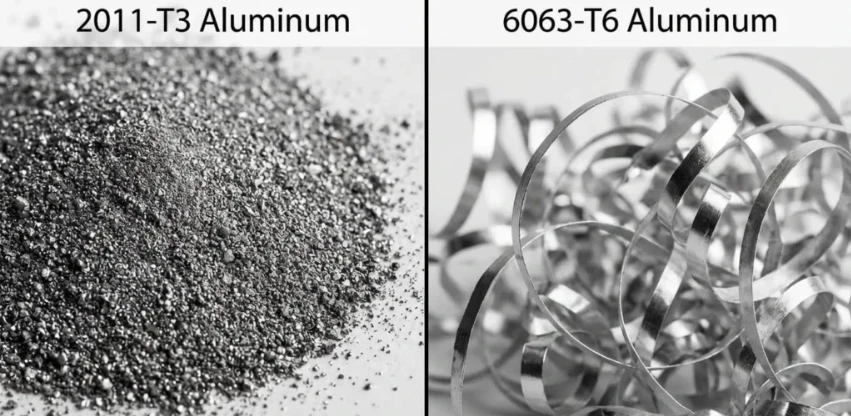
6061-T6 and 6061-T651
6061-T6 is the workhorse of general CNC manufacturing. It machines consistently, holds tight tolerances, and accepts most surface finishing processes.
For large plate parts or precision fixtures, 6061-T651 reduces post-machining distortion thanks to its stress relieved aluminum structure.
When to Choose 6061 vs 7075
A very common engineering question is the CNC machining aluminum parts 6061 and 7075 comparison. 6061 offers better corrosion resistance, easier machining, and lower cost. 7075 offers much higher strength but is more abrasive and more expensive.
The table below helps with quick side-by-side selection:
| Attribute | 6061-T6 | 7075-T6 |
|---|---|---|
| Tensile Strength | ~310 MPa | ~505 MPa |
| CNC Machinability | Excellent | Good (more abrasive) |
| Corrosion Resistance | Very good | Moderate |
| Cost Level | Medium | High |
| Typical Use | Frames, brackets, enclosures | High-load structural parts, tooling |
6000 series alloys are widely used across industrial automation CNC machined parts, electronics housings, and semiconductor fixture components.
The 7000 Series (Zinc-Alloyed) – The Heavy Hitters
7000 series aluminum alloys use zinc as the primary alloying element, often combined with magnesium and copper. They are the highest-strength aluminum family used in CNC machining.
7075-T6 is the most common grade in this series. It is chosen when part weight must stay low but mechanical loads are high.
Performance and Tradeoffs
7075-T6 delivers outstanding strength-to-weight ratio, but it is harder on cutting tools than 6061. It also has lower corrosion resistance and is not recommended for marine or highly corrosive environments without coating.
It is well suited for 5 axis CNC machined parts with complex aerospace or defense structural geometries.
Typical Applications
7000 series alloys appear in aerospace frames, high-performance bicycle components, tooling jigs, robotics arms, and motorsport parts.
If your project requires high-strength aluminum with tight dimensional control, our team can recommend the optimal grade and temper.
The "Gummy" Series (1xxx, 3xxx, 5xxx) – Proceed with Caution
Non-heat treatable aluminum series such as 1xxx, 3xxx, and 5xxx are not first-choice for heavy milling operations. They tend to produce long, stringy chips that can clog tool flutes and damage surface finish.
That said, they still have important roles in CNC manufacturing when specified correctly.
5052-H32
5052-H32 is the most common CNC grade in this group. It has excellent corrosion resistance, especially in marine and outdoor environments.
It performs better in CNC turned parts and sheet-based operations than in deep 3D milling.
Recommended Machining Practices
For gummy aluminum grades, use sharp polished tools, higher spindle speeds, and reliable chip clearance. Climb milling and proper coolant delivery also help improve finish and tool life.
If you are unsure whether a non-heat treatable grade fits your design, we can suggest alternatives or process adjustments.
How to Select the Right Aluminum Grade & Temper
Start by defining your core requirements: mechanical load, corrosion environment, tolerance level, surface finish, and budget.
Then match those requirements to the alloy family and temper that delivers the best balance of performance and machinability.
The table below provides a quick selection checklist for common CNC part types:
| Part Type | Recommended Grade & Temper | Key Reason |
|---|---|---|
| General structural bracket | 6061-T6 | Good strength, low cost, easy machining |
| Large precision plate / fixture | 6061-T651 | Stress relieved, minimal distortion |
| High-strength aerospace fitting | 2024-T3 or 7075-T6 | High strength, excellent chip control |
| Marine / outdoor enclosure | 5052-H32 | Strong corrosion resistance |
| High-load robotics arm | 7075-T6 | Best strength-to-weight ratio |
For final validation, always share your full drawing and performance requirements with your machining supplier early in the design phase.
Send Your Drawing for DFM Feedback
FAQ
Q: What is the difference between an aluminum grade and an aluminum temper?
A: The aluminum grade defines the chemical composition and alloying elements. The temper defines the mechanical and physical properties achieved through heat treatment, cold work, or stress relief. Both are required for a complete material specification.
Q: Is 6061-T6 the same as 6061-T651?
A: No. 6061-T6 is solution heat treated and artificially aged. 6061-T651 receives an additional stress-relief stretching step after quenching, which reduces internal stress and lowers post-machining distortion risk.
Q: What does O temper mean in aluminum?
A: O temper means the aluminum is fully annealed. It is soft and ductile, making it easy to form, but it generally gives poor chip control during CNC milling.
Q: What is the most machinable aluminum alloy for CNC?
A: Free machining grades such as 2024-T3 and other 2000 series alloys offer excellent chip breaking. For general-purpose work, 6061-T6 is also considered highly machinable and cost-effective.
Q: What is the difference between heat treatable and non-heat treatable aluminum alloys?
A: Heat treatable aluminum alloys gain significant strength through solution heat treatment and aging. Non-heat treatable alloys rely on alloying elements and cold work for strength, and they cannot be strengthened through thermal treatment alone.
Q: Should I use 6061 or 7075 for my CNC part?
A: Choose 6061-T6 for general structural parts, better corrosion resistance, and lower cost. Choose 7075-T6 when high strength-to-weight ratio is critical and higher material and machining cost is acceptable.
Q: What is stress relieved aluminum used for?
A: Stress relieved aluminum such as 6061-T651 is used for large plates, precision fixtures, and tight-tolerance structural parts where post-machining warping or dimensional shift must be minimized.
Q: What is 5052-H32 aluminum commonly used for?
A: 5052-H32 is commonly used for marine components, outdoor enclosures, sheet metal parts, and applications where corrosion resistance is more important than ultra-high strength.
Q: Can you CNC machine soft O temper aluminum?
A: Yes, but soft O temper aluminum tends to produce gummy, stringy chips. It works better for forming and bending operations than for high-precision 3D milling.
Q: What aluminum grades are commonly used in aerospace?
A: Common aerospace aluminum alloys include 2024-T3, 6061-T6, 6061-T651, and 7075-T6. The final choice depends on strength requirements, fatigue performance, and operating environment.
Q: How do I know which temper is best for my CNC project?
A: Evaluate your part's load, tolerance, corrosion exposure, and production process. A CNC machining supplier with material expertise can review your drawing and recommend the optimal grade and temper combination.
Q: Does aluminum temper affect CNC machining cost?
A: Yes. Harder or more abrasive tempers can increase tool wear and cycle time. Stress relieved grades may have higher material cost, but they can reduce scrap from post-machining distortion on precision parts.


