


The Definitive Guide to CNC Material Selection
Smart CNC material selection balances end-use performance, production cost, and lead time for every precision component project.
This guide evaluates 7 core CNC materials through both material science properties and CNC machinability rating metrics, so engineering and procurement teams can make data-driven choices.
We break down grade-specific characteristics, common applications, and machining tradeoffs to streamline your sourcing workflow.
Aluminum Alloys: The King of CNC Material
Aluminum alloys CNC parts account for over 60% of general precision machining orders due to their excellent strength-to-weight ratio and low processing cost.
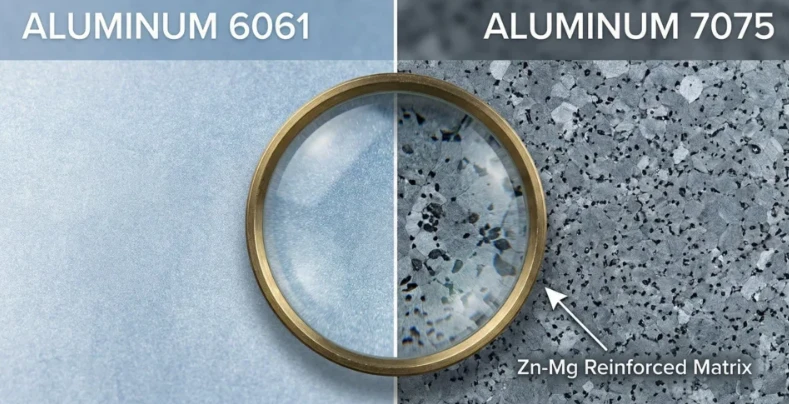
Common Aluminum Grades and Performance
Two heat-treated grades dominate industrial CNC projects, with distinct mechanical profiles for different load requirements.
| Grade | Tensile Strength (MPa) | Corrosion Resistance | Core Advantage |
|---|---|---|---|
| 6061-T6 aluminum | 310 | Good | Balanced strength and formability |
| 7075-T6 aluminum | 570 | Moderate | Ultra-high strength for structural parts |
Machinability and Applications
Aluminum scores 80-90% on standard machinability scales, enabling high feed rates and minimal tool wear CNC machining downtime.
6061-T6 is widely used for electronics enclosures and automation brackets, while 7075-T6 serves aerospace structural components.
For custom aluminum component sourcing, our aluminum CNC machined parts service delivers tight tolerance results with fast turnaround.
Stainless Steels: The Cost of Corrosion Resistance
Stainless steel CNC machining delivers superior corrosion resistance, but higher material hardness increases processing time and tooling costs.
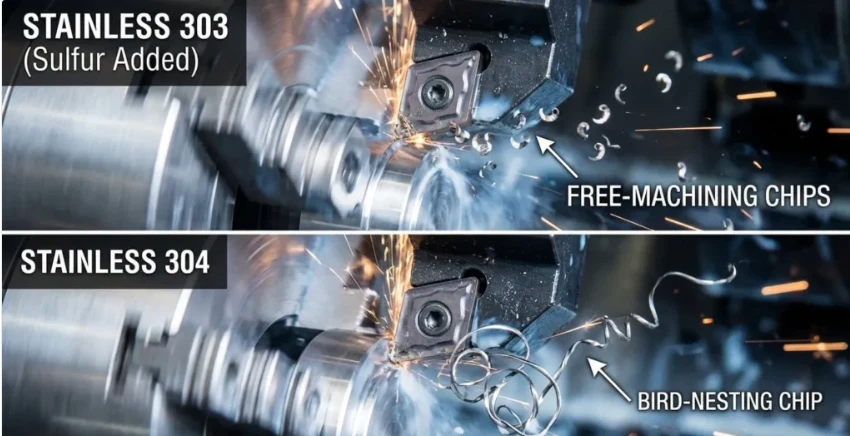
Grade Comparison and Tradeoffs
Austenitic stainless grades are the most widely specified, with clear differences in chemical resistance and machinability.
| Grade | Chromium/Nickel Content | Corrosion Resistance | Machinability Rating |
|---|---|---|---|
| 304 stainless steel | 18% Cr / 8% Ni | Good for indoor/moderate environments | 50% |
| 316 stainless steel | 16% Cr / 10% Ni / 2% Mo | Excellent for marine/chemical exposure | 45% |
Use Cases and Machining Notes
Poor chip formation CNC control in stainless machining can cause work hardening, so rigid tooling and constant feed rates are required.
304 stainless is standard for food equipment and medical device housings, while 316 is preferred for marine fittings and chemical processing parts.
Our stainless steel CNC machined parts line supports both prototyping and high-volume production with certified material traceability.
Carbon & Alloy Steels: The Backbone of Industry
Carbon steel CNC and alloy steel parts form the structural foundation of heavy industry, automotive, and equipment manufacturing.
Key Steel Grades and Strength Properties
Carbon content directly impacts hardness, tensile strength, and machinability across standard steel grades.
| Grade | Carbon Content | Tensile Strength (MPa) | Primary Characteristic |
|---|---|---|---|
| 1018 steel | 0.18% | 440 | High ductility, easy to weld and form |
| 4140 chromoly alloy | 0.40% C / 1% Cr / 0.2% Mo | 655 (quenched/tempered) | High fatigue resistance |
Machining and Industrial Applications
1018 steel has a 70% machinability rating, making it ideal for low-stress structural parts and fasteners.
4140 chromoly is used for automotive shafts, hydraulic components, and high-strength machine parts after heat treatment.
Our steel CNC machined parts service covers both carbon and alloy steel grades with optional heat treatment and finishing.
Copper & Brass: Conductivity vs. Machinability
Copper brass CNC machining serves electrical and thermal management applications where conductivity is a critical design requirement.
Material Properties and Conductivity
Copper offers the highest electrical conductivity, while brass adds zinc to improve machinability and reduce material cost.
| Material | Electrical Conductivity (% IACS) | Machinability Rating | Core Use Case |
|---|---|---|---|
| Copper | 100 | 60% | High-current electrical contacts |
| C360 free cutting brass | 28 | 90% | Precision fittings and connectors |
Machining Characteristics and Applications
C360 brass produces uniform chips and supports high-speed machining, making it the top choice for mass-produced small components.
Copper parts are common in power transmission systems and heat exchangers, while brass is used for plumbing fittings and electronic connectors.
Our copper CNC machined parts and brass CNC machined parts services ensure precise dimensional control for conductive components.
Titanium: The Aerospace Elite
Titanium CNC machining delivers exceptional strength-to-weight ratio and biocompatibility, but presents significant processing challenges.

Titanium Grade Performance
Ti-6Al-4V is the most widely used titanium alloy, balancing strength, corrosion resistance, and moderate formability.
| Grade | Tensile Strength (MPa) | Density (g/cm³) | Key Benefit |
|---|---|---|---|
| Ti-6Al-4V | 900 | 4.43 | High strength, 40% lighter than steel |
Machining Challenges and High-End Applications
Titanium retains 80% of its strength at high cutting temperatures, accelerating tool wear CNC machining and requiring slow feed rates.
This material is the standard for aerospace CNC materials structural components and medical CNC materials implantable devices.
Our titanium CNC machined parts service uses specialized tooling and coolant systems to achieve tight tolerance results.
Discuss Titanium Project Requirements
Precision CNC Machining Materials Selection Checklist
Use this quick decision framework to narrow down precision CNC machining materials for your next project.
| Requirement Category | Key Evaluation Questions | Recommended Material Priority |
|---|---|---|
| Mechanical Load | Does the part bear high static or dynamic stress? | 4140 chromoly, 7075 aluminum, titanium |
| Environmental Exposure | Will the part face moisture, chemicals, or salt spray? | 316 stainless, 6061 aluminum, titanium |
| Cost Target | Is unit cost the primary project constraint? | 1018 steel, 6061 aluminum, C360 brass |
| Conductivity | Does the part require electrical or thermal conductivity? | Copper, C360 brass, 6061 aluminum |
| Weight Limit | Is weight reduction a critical design goal? | 6061/7075 aluminum, titanium |
For complex multi-part assemblies, work with your machining partner early to optimize material choices for both performance and manufacturability.
FAQ
Q: What is the most cost-effective CNC material for general-purpose parts?
A: 6061-T6 aluminum is the most cost-effective choice for most low-to-medium stress applications, thanks to its high machinability, low material cost, and good corrosion resistance.
Q: How does CNC machinability rating affect production cost?
A: A higher machinability rating means faster cutting speeds, longer tool life, and lower scrap rates, directly reducing per-part production cost and lead time.
Q: Which stainless steel grade is best for marine environments?
A: 316 stainless steel is the preferred choice for marine applications, as its molybdenum content provides superior resistance to saltwater corrosion compared to 304 stainless.
Q: What is the difference between 6061-T6 and 7075-T6 aluminum?
A: 7075-T6 has nearly double the tensile strength of 6061-T6, making it suitable for high-stress structural parts, while 6061-T6 offers better corrosion resistance and lower cost.
Q: Is titanium machining more expensive than stainless steel?
A: Yes, titanium machining is typically 2-3 times more expensive than stainless steel due to higher material cost, slower cutting speeds, and increased tool wear.
Q: What material is best for electrical connector parts?
A: C360 free cutting brass is the top choice for electrical connectors, balancing good conductivity, excellent machinability, and low material cost for high-volume production.
Can 4140 chromoly steel be used for high-temperature applications?
4140 chromoly maintains good strength at moderate temperatures up to 425°C, making it suitable for automotive engine and industrial equipment components.
Q: How do I choose between carbon steel and stainless steel?
A: Choose carbon steel for high-strength, low-cost indoor applications, and stainless steel when corrosion resistance or sanitary requirements are critical.
Q: What factors influence chip formation in CNC machining?
A: Material hardness, cutting speed, tool geometry, and coolant application all impact chip formation, which directly affects surface finish and tool life.
Q: Which materials are commonly used for aerospace CNC parts?
A: 7075-T6 aluminum, Ti-6Al-4V titanium, and 304/316 stainless steel are the most common aerospace CNC materials, meeting strict strength and weight requirements.
Q: What medical-grade CNC materials are FDA-approved for implants?
A: Ti-6Al-4V titanium and 316L stainless steel are the most widely used medical CNC materials, offering biocompatibility and corrosion resistance for implantable devices.
Q: How can I reduce tool wear when machining hard materials?
A: Use rigid machine setups, specialized coated cutting tools, optimized feed rates, and high-pressure coolant systems to minimize tool wear when machining hard materials.


