


Stainless steel stands as the go-to material for components exposed to corrosive fluids, extreme temperatures, and heavy mechanical stress. For engineers and procurement teams, sourcing reliable stainless steel CNC machining services often brings pain points: inconsistent tolerances, long lead times, and unexpected cost overruns for custom parts.
This guide breaks down everything you need to know about custom stainless steel machining, from material grade selection to surface finishing, and how to pick the right manufacturing partner for your project.
Why Stainless Steel? Understanding the Material
Stainless steel is an iron-based alloy with a minimum of 10.5% chromium, which forms a passive oxide layer that resists rust and corrosion. This property makes it ideal for parts used in harsh operating environments.
Compared to standard carbon steel, stainless steel offers superior corrosion resistance, higher strength at elevated temperatures, and better aesthetic appeal for visible components. These benefits come with unique machining challenges that require specialized equipment and process control.
Common machining challenges for stainless steel include high work hardening rates, poor thermal conductivity, and built-up edge on cutting tools. Without proper process tuning, these issues can lead to short tool life, poor surface finish, and dimensional inaccuracy.
Get a Free DFM Review for Your Stainless Steel Parts
Popular Grades We Machine
Selecting the right stainless steel grade is critical to balance performance, machinability, and cost for your custom parts. Below is a comparison of the most commonly machined grades in our facility.

Selection guide: Machinability index and physical properties of common stainless steel grades.
| Grade | Key Properties | Common Applications | Machinability Rating |
|---|---|---|---|
| 304 stainless steel | Good corrosion resistance, excellent formability | Food processing equipment, general industrial parts | Moderate |
| 316L stainless steel | Superior corrosion resistance (chloride environments), low carbon | Marine components, chemical processing, medical devices | Lower than 304 |
| 17-4PH stainless steel | High strength, hardness after heat treatment | Aerospace components, valve parts, tooling | Moderate (post-heat treat requires rigid setup) |
| 303 stainless steel | Free-machining, added sulfur | Fasteners, fittings, high-volume turned parts | Excellent |
For cost-sensitive projects with moderate corrosion needs, 304 stainless steel machining delivers the best value. For parts exposed to saltwater or harsh chemicals, 316L stainless steel machining is the standard choice. For high-strength applications, 17-4PH stainless steel machining offers unmatched mechanical performance after precipitation hardening.
If you need help selecting the optimal grade for your design, our engineering team can provide material recommendations based on your operating environment and budget.
Our Core Capabilities: Comprehensive Stainless Steel CNC Machining Services
We offer a full suite of CNC processes to produce custom stainless steel parts for every industry and complexity level.
CNC Milling Services
Our CNC milling services handle prismatic parts with complex geometries, from simple brackets to intricate manifold housings. We work with 3-axis and 4-axis milling setups for low to medium complexity parts.
Typical applications include CNC machined brackets, flanges, and equipment housings. We hold tight tolerances up to ±0.005 mm for critical features, with in-process inspection to ensure consistency across batches.
Learn more about our milling capabilities on our CNC milled parts page.
CNC Turning Services
Our CNC turning services produce rotational parts such as shafts, bushings, and valve components with high concentricity and surface finish. We support both bar-fed and chucked workpieces for small and large diameter parts.
For high-volume production of small precision parts, we combine turning with secondary milling operations via turn-mill centers to reduce setup time and improve accuracy.
Explore our full turning portfolio on the CNC turned parts page.
5-Axis CNC Machining
For complex geometries that require multiple setups on 3-axis machines, our 5-axis CNC machining capability delivers one-setup machining for impellers, turbine blades, and complex aerospace components.

5-Axis simultaneous motion control and tool vector kinematics for complex geometries.
The RTCP (Rotation Tool Center Point) control ensures consistent tool engagement across curved surfaces, resulting in better surface finish and shorter lead times for complex parts. This process is ideal for aerospace CNC components and custom impeller designs.
Discover more about our 5-axis capabilities on our 5 axis CNC machined parts page.
Request a Custom Quote for Stainless Steel Machining
Technical Challenges and How We Overcome Them
Stainless steel machining presents unique technical hurdles that separate experienced shops from general-purpose machining providers. Here is how we address the most common challenges.
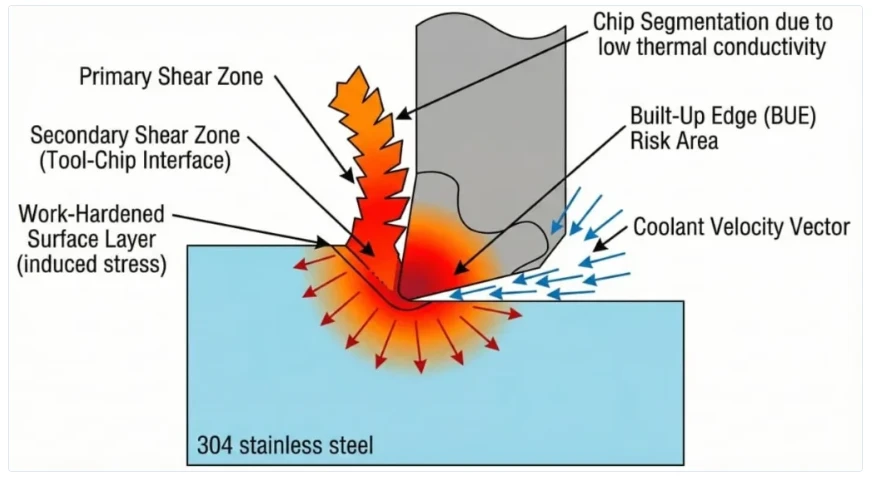
Analysis of thermal distribution and chip formation zones during the machining process.
| Challenge | Root Cause | Our Solution |
|---|---|---|
| Work hardening | High ductility causes surface hardening during cutting | Constant chip load control, sharp tooling, climb milling |
| Poor heat dissipation | Low thermal conductivity traps heat at cutting edge | High-pressure coolant (70+ bar) through-tool delivery |
| Built-up edge | Sticky material adheres to tool rake face | Coated carbide inserts, optimized feed rates, proper coolant concentration |
| Dimensional drift | Thermal expansion of workpiece during machining | In-process temperature compensation, finish pass at stable temperature |
Our process engineers develop custom machining parameters for each stainless steel grade to maximize tool life, reduce cycle time, and maintain consistent part quality across production runs.
Surface Finishing for Stainless Steel Parts
Stainless steel parts often require surface treatment to enhance corrosion resistance, improve appearance, or meet specific functional requirements. We offer a full range of stainless steel surface finishing options.

Comparative analysis of surface integrity: As-Machined vs. Passivated vs. Electropolished.
| Finish Type | Typical Ra Value | Primary Benefit | Common Applications |
|---|---|---|---|
| As-machined | 1.6 – 3.2 μm | Lowest cost, standard industrial finish | Internal components, structural parts |
| Bead blasting | 0.8 – 1.6 μm | Uniform matte appearance, removes tool marks | Visible equipment parts, consumer-facing components |
| Electropolishing | 0.2 – 0.8 μm | Enhanced corrosion resistance, smooth easy-to-clean surface | Medical device CNC parts, food processing equipment |
| Passivation | 0.8 – 1.6 μm | Removes free iron, boosts corrosion resistance | Marine CNC components, chemical processing parts |
For projects requiring specific surface roughness or compliance with industry standards, we can provide third-party surface finish testing reports upon request.
Explore our full range of finishing options on our CNC surface finishing services page.
How to Choose the Best Partner for Your Project
Selecting the right CNC machining partner directly impacts your product quality, lead time, and total cost. Evaluate potential vendors using these key criteria.

Example of strict GD&T tolerance controls applied to precision turned components.
| Evaluation Criterion | What to Look For | Why It Matters |
|---|---|---|
| Quality certifications | ISO 9001, ISO 13485, AS9100 as applicable | Ensures consistent process control and traceability |
| DFM support | Free design for manufacturing review before production | Reduces costly design revisions and improves part manufacturability |
| Material expertise | Proven experience with your specific stainless steel grade | Avoids common machining defects and material waste |
| Tolerance capability | Documented ability to hold your required GD&T tolerances | Prevents assembly issues and functional failures |
| Pricing transparency | Itemized quotes with material, machining, and finishing costs | Helps you budget accurately and avoid hidden fees |
If you are evaluating the best CNC machining service for brass and stainless steel, look for a partner with deep experience across both material families to streamline your supply chain.
Upload Your CAD File for Free Quotation
Comparing Stainless Steel to Other Metals
When selecting a material for your custom parts, it is important to balance performance requirements with machining cost. Below is a comparison of stainless steel with other common machinable metals.
| Material | Relative Machining Cost | Corrosion Resistance | Strength | Typical Use Case |
|---|---|---|---|---|
| Stainless steel | High | Excellent | High | Corrosive environments, food/medical, high-strength parts |
| Brass | Low | Good | Moderate | Electrical connectors, decorative parts, low-friction components |
| Aluminum | Low-Medium | Good (with coating) | Low-Medium | Lightweight structures, heat sinks, enclosures |
| Carbon steel | Medium | Poor (requires coating) | High | Structural components, tooling, heavy machinery |
| Titanium | Very High | Excellent | Very High | Aerospace, medical implants, high-performance applications |
| Copper | Medium | Good | Low | Electrical conductors, heat exchangers, plumbing |
| Alloy steel | Medium-High | Poor (requires coating) | Very High | Gears, shafts, high-load mechanical components |
For projects where corrosion resistance is critical and budget is a concern, start with 304 stainless steel machining and upgrade to 316L only if your environment requires enhanced chloride resistance.
Case Study: Custom Valve Components for the Oil & Gas Industry
A client in the oil and gas sector approached us with a requirement for oil and gas valve components made from 316L stainless steel. The parts required tight dimensional tolerances, high corrosion resistance, and full material traceability.
The initial design presented machining challenges: deep internal bores, tight concentricity requirements, and a smooth surface finish for sealing surfaces. Our engineering team conducted a DFM review and recommended minor design adjustments to reduce machining time and improve tool life.
We produced the parts using turn-mill machining with high-pressure coolant, followed by electropolishing and passivation for maximum corrosion resistance. All parts passed 100% dimensional inspection and pressure testing, meeting the client's strict quality requirements.
The client reduced their per-part cost by 18% compared to their previous supplier, while cutting lead time from 6 weeks to 3 weeks for recurring orders.
FAQ
Q: What is the typical lead time for stainless steel CNC machining services?
A: Standard lead time for prototype parts is 5-7 business days, while production runs typically take 2-4 weeks depending on part complexity, order volume, and required surface finishing. Rush services are available for urgent projects.
Q: What tolerances can you hold for stainless steel parts?
A: We can hold general tolerances of ±0.05 mm for standard parts, and tight tolerance up to ±0.005 mm for critical features depending on part geometry and size. All tolerance claims are verified with calibrated inspection equipment.
Q: Do you offer wholesale stainless steel CNC machining services for high-volume orders?
A: Yes, we offer wholesale stainless steel CNC machining services for production volumes ranging from 100 to 10,000+ parts. Volume pricing discounts are applied automatically based on order quantity.
Q: What stainless steel grades do you machine?
A: We regularly machine 304, 303, 316L, 17-4PH, and other common stainless steel grades. All material is sourced from certified mills with full material test reports available upon request.
Q: Can you provide both CNC milling and CNC turning for the same part?
A: Yes, our turn-mill centers combine CNC milling services and CNC turning services in a single setup, reducing handling time and improving dimensional accuracy for parts with both rotational and prismatic features.
Q: Do you offer 5-axis CNC machining for complex stainless steel parts?
A: Yes, our 5-axis CNC machining capability supports complex geometries such as impellers, turbine blades, and contoured aerospace components that cannot be efficiently produced on 3-axis machines.
Q: How do you ensure quality for stainless steel parts?
A: We follow a strict quality control process including incoming material inspection, in-process dimensional checks, and final CMM inspection. We are ISO 9001 certified and can provide full inspection reports with every shipment.
Q: Are cheap price stainless steel CNC machining services reliable?
A: Low pricing often comes with trade-offs in material quality, tooling, or inspection. We offer competitive pricing while maintaining strict quality standards, and we provide transparent itemized quotes so you know exactly what you are paying for.
Q: What surface finishing options are available for stainless steel parts?
A: We offer a full range of finishes including as-machined, bead blasting, electropolishing, passivation, and polishing. Our stainless steel surface finishing services can be tailored to your functional and aesthetic requirements.
Q: Can you help with material selection for my project?
A: Absolutely. Our engineering team can recommend the optimal stainless steel grade based on your application requirements, operating environment, and budget to help you get the best performance at the lowest cost.
Q: Do you serve the aerospace and medical device industries?
A: Yes, we produce aerospace CNC components and medical device CNC parts with full traceability and compliance with relevant industry standards. We also serve marine, industrial automation, and semiconductor sectors.
Q: How do I get a quote for my custom stainless steel parts?
A: Simply send your CAD files (STEP, IGES, or SolidWorks format) along with your quantity, material, and finish requirements to our sales team, and you will receive a detailed quote within 24 business hours.


