


Titanium stands as one of the most sought-after premium materials for CNC machining, prized for its unmatched strength-to-weight ratio, corrosion resistance, and biocompatibility. From aerospace structural components to life-saving medical implants, titanium parts deliver performance that few other materials can match.
Yet, working with titanium is far from straightforward. Its unique physical properties create significant machining challenges that can lead to tool wear, dimensional inaccuracy, and even safety risks if not handled properly.
This guide breaks down everything engineering and procurement teams need to know about titanium CNC machining, from core material grades and processing hurdles to cost-saving strategies and real-world quality examples.
Key Titanium Grades for CNC Machining
Selecting the right titanium grade is the first critical step in any machining project, as each grade offers distinct chemical compositions, mechanical properties, and machinability characteristics. Below are the three most widely used grades in industrial and medical manufacturing.
Grade 5 Titanium (Ti-6Al-4V)
As the most popular titanium alloy, Grade 5 titanium (also known as Ti-6Al-4V) accounts for over 50% of all titanium used globally. It contains 6% aluminum and 4% vanadium, which boost its strength and heat resistance compared to pure titanium.
It offers high tensile strength, excellent corrosion resistance, and good formability, making it a top choice for aerospace titanium parts, automotive components, and industrial equipment. Its machinability is moderate, requiring rigid tooling and controlled cutting parameters to avoid premature tool failure.
Grade 2 Titanium
Grade 2 titanium is a commercially pure (CP) grade with minimal alloying elements, delivering superior ductility, formability, and corrosion resistance. It is softer and easier to shape than Grade 5, though it has lower tensile strength.
This grade is commonly used for marine components, chemical processing equipment, and architectural applications where corrosion resistance and formability take priority over extreme strength. Its machinability is better than Grade 5, but it still requires careful heat management during cutting.
Grade 23 Titanium (Medical Grade)
Grade 23 titanium, a modified version of Ti-6Al-4V with reduced oxygen and iron content, is the gold standard for medical titanium alloys. It offers excellent biocompatibility, high fatigue strength, and superior ductility compared to standard Grade 5.
It is the primary material for medical titanium implants such as hip replacements, dental implants, and surgical instruments, where long-term biocompatibility and structural reliability are non-negotiable. Its machinability is similar to Grade 5, with extra requirements for surface finish and contamination control.
| Titanium Grade | Key Alloying Elements | Core Strengths | Primary Applications | Machinability Rating |
|---|---|---|---|---|
| Grade 5 (Ti-6Al-4V) | 6% Al, 4% V | High strength, heat resistance | Aerospace, automotive, industrial | Moderate |
| Grade 2 | Low impurity (CP) | Ductility, corrosion resistance | Marine, chemical processing | Good |
| Grade 23 | Low oxygen Ti-6Al-4V | Biocompatibility, fatigue strength | Medical implants, surgical tools | Moderate |
Get a Custom Titanium Machining Quote
Why is Titanium CNC Machining So Difficult?
Titanium machining difficulty stems from three core material properties that set it apart from common metals like aluminum and steel. Understanding these challenges is essential for achieving consistent, high-quality results.
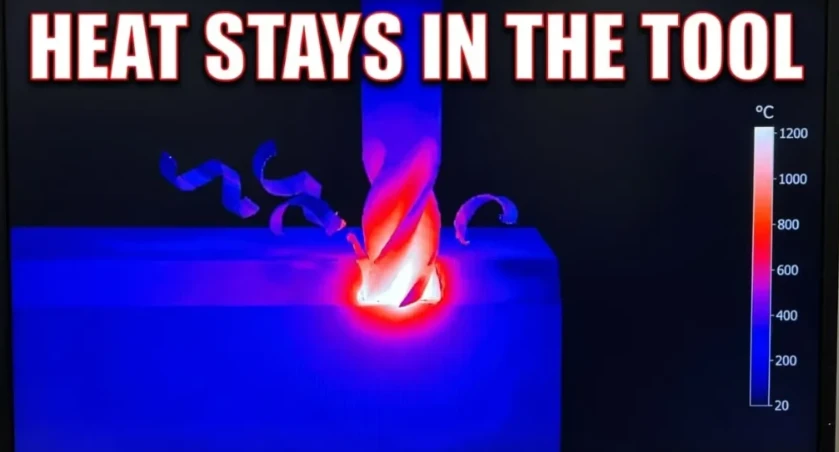
Heat Trap Effect
Titanium has extremely low thermal conductivity, meaning heat generated during cutting does not dissipate quickly through the workpiece. Instead, up to 80% of the heat concentrates at the cutting edge of the tool, accelerating tool wear and causing dimensional drift.
The most effective solution is high-pressure coolant for titanium machining, delivered directly to the cutting zone at pressures of 70–100 bar. This flushes away chips rapidly and carries off excess heat, extending tool life by up to 30%.
Work Hardening
Titanium work hardening occurs when the material's surface layer becomes harder and more brittle under mechanical stress during cutting. This hardened layer can cause chipping, tool breakage, and poor surface finish if cutting parameters are not adjusted properly.
To mitigate work hardening, machinists use sharp, rigid cutting tools, maintain consistent feed rates, and avoid dwell times that let the tool rub against the workpiece surface. Climb milling is also preferred over conventional milling to reduce work hardening risk.
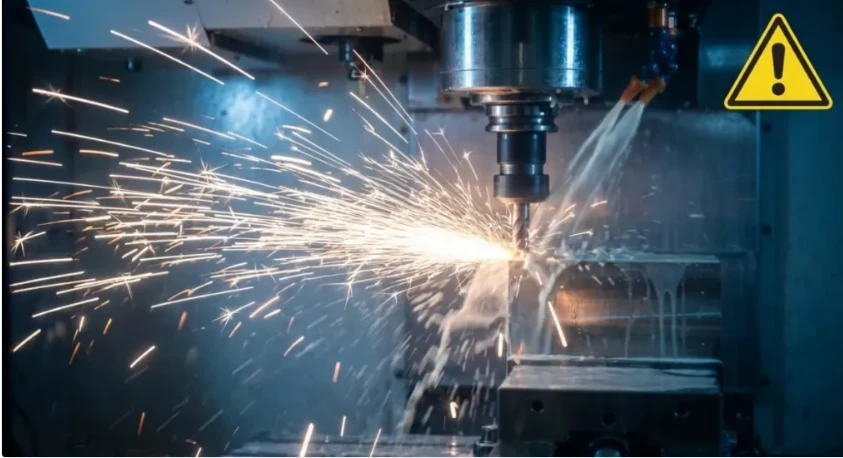
Fire Hazard
Fine titanium chips produced during machining are highly reactive and can ignite spontaneously when exposed to high temperatures and oxygen, creating a significant titanium fire hazard machining risk. This is especially dangerous in dry cutting or high-speed operations.
Preventive measures include using flood coolant to keep chips cool and contained, avoiding excessive cutting speeds, and keeping the work area free of flammable materials. Shops must also have Class D fire extinguishers on hand for titanium-specific fires.
Titanium vs. Alternative Machining Materials
Choosing between titanium and other common CNC materials depends on your project's performance requirements, budget, and operating environment. Below is a comparison of titanium with three widely used engineering metals.
| Material | Strength-to-Weight Ratio | Corrosion Resistance | Machining Cost | Typical Applications |
|---|---|---|---|---|
| Titanium | Excellent | Outstanding | High | Aerospace, medical, marine |
| Aluminum | Good | Good | Low | Electronics, automotive, general industrial |
| Stainless steel | Moderate | Very good | Moderate | Food equipment, industrial valves |
| Carbon steel | Good | Poor | Low | Structural parts, heavy equipment |
When weight savings and corrosion resistance are critical, titanium is often the only viable option, despite its higher material and processing costs. For projects where weight is less of a concern, aluminum or stainless steel may offer a more cost-effective solution.
For high-precision aerospace applications that demand both light weight and extreme durability, titanium remains the industry standard. You can learn more about material-specific machining capabilities on our dedicated titanium CNC machined parts page.
Visualizing Titanium CNC Machining Quality
High-quality titanium CNC parts require tight process control, from material selection and tooling setup to final inspection. The image below showcases two representative precision titanium components produced with advanced CNC technology.
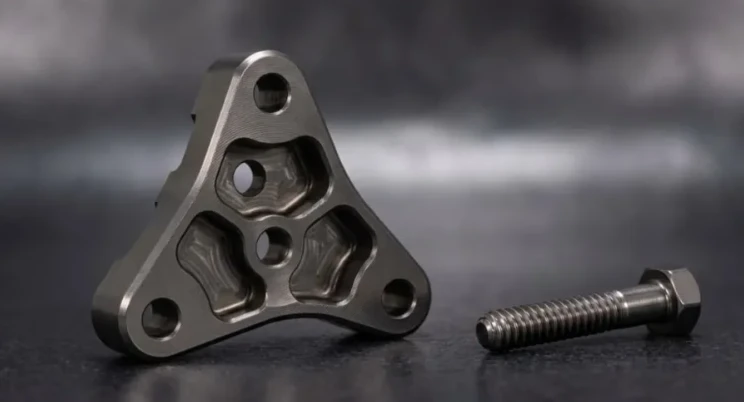
The Grade 5 aerospace bracket demonstrates tight tolerance machining, with complex geometric features and a smooth surface finish suitable for structural load-bearing applications. The medical implant component, made from Grade 23 titanium, meets strict biocompatibility and surface roughness requirements for surgical use.
Both parts require multi-axis machining capabilities to achieve their complex shapes, along with rigorous quality checks to ensure dimensional accuracy and material integrity.
For aerospace-grade titanium components, compliance with industry-specific quality standards is non-negotiable. Our aerospace CNC machined parts service follows strict process controls to meet the highest industry requirements.
Tips for Reducing Costs in Titanium CNC Machining
While titanium machining is inherently more expensive than working with aluminum or steel, there are several practical strategies to reduce titanium machining cost without compromising quality.
1. Optimize part design for manufacturability (DFM): Simplify complex features, minimize deep cavities, and use standard tool sizes to reduce machining time and tool wear.
2. Choose the right grade: Select the lowest-grade titanium that meets your performance requirements. For example, use Grade 2 instead of Grade 5 if high strength is not critical.
3. Optimize batch size: Larger production runs spread tooling and setup costs across more parts, reducing per-unit costs significantly.
4. Minimize secondary operations: Integrate features that can be machined in a single setup, and avoid unnecessary surface finishing steps.
5. Work with an experienced titanium machining partner: A specialist with proven titanium processing expertise can reduce scrap rates, shorten lead times, and avoid costly rework.
For prototype projects, combining design optimization with rapid prototyping services can also help validate designs before full-scale production, reducing overall project risk and cost.
Discuss Your Titanium Project Cost Optimization
Ready for Your Titanium Machining Project?
Titanium CNC machining offers exceptional performance benefits, but it requires specialized expertise, proper equipment, and strict process controls to deliver consistent, cost-effective results. From selecting the right titanium grade to managing heat, work hardening, and fire risks, every step of the process demands careful attention.
At Alloys Metal, we specialize in precision titanium machining for aerospace, medical, automotive, and industrial applications. Our team of experienced engineers and machinists has deep expertise working with Grade 2, Grade 5, and medical Grade 23 titanium, delivering parts that meet the tightest tolerance and quality requirements.
We support projects from prototype to full production, with in-house quality inspection to ensure every part meets your specifications. Whether you need a single custom titanium component or a large production run, we can tailor our services to your needs.
FAQ
Q: What is the most commonly used titanium grade for CNC machining?
A: Grade 5 titanium (Ti-6Al-4V) is the most widely used grade, accounting for over half of all titanium machining applications. It balances strength, corrosion resistance, and machinability, making it suitable for aerospace, automotive, and industrial parts.
Q: Why is titanium harder to machine than aluminum?
A: Titanium has low thermal conductivity that traps heat at the cutting edge, a high tendency for work hardening, and higher strength that puts more stress on tools. These factors lead to faster tool wear and require more controlled cutting parameters compared to aluminum.
Q: What is the best coolant for titanium machining?
A: High-pressure coolant (70–100 bar) delivered directly to the cutting zone is the standard for titanium machining. It effectively removes heat, flushes away chips, and reduces tool wear, while also lowering the risk of titanium chip ignition.
Q: Can titanium be used for medical implants?
A: Yes, medical-grade titanium alloys such as Grade 23 are the gold standard for medical implants. They are biocompatible, corrosion-resistant, and have a strength-to-weight ratio that closely matches human bone, making them ideal for hip, knee, and dental implants.
Q: How can I reduce titanium machining costs?
A: Key cost-saving strategies include optimizing part design for manufacturability, selecting the appropriate titanium grade, increasing batch sizes, minimizing secondary operations, and working with an experienced titanium machining partner.
Q: What safety risks are associated with titanium machining?
A: The primary safety risk is fire from fine, hot titanium chips that can ignite spontaneously. Proper flood coolant, controlled cutting speeds, and Class D fire extinguishers are essential safety measures for any titanium machining operation.
Q: What is the difference between Grade 2 and Grade 5 titanium?
A: Grade 2 is commercially pure titanium with excellent ductility and corrosion resistance but lower strength. Grade 5 is an alloy with aluminum and vanadium, offering much higher strength and heat resistance but slightly lower machinability.
Q: What industries use CNC machined titanium parts most?
A: Aerospace, medical, marine, and chemical processing are the top industries for titanium parts. Aerospace uses it for structural components to reduce weight, while medical uses it for biocompatible implants and surgical instruments.
Q: What tolerance can be achieved with titanium CNC machining?
A: With proper tooling and process control, titanium parts can achieve tight tolerances of ±0.005 mm or better, depending on part complexity and size. Precision grinding can achieve even tighter tolerances for critical applications.
Q: Is Grade 23 titanium the same as Ti-6Al-4V?
A: Grade 23 is a modified version of Ti-6Al-4V with lower oxygen and iron content. It offers improved ductility and fatigue strength compared to standard Grade 5, making it the preferred choice for medical implant applications.
Q: How does work hardening affect titanium machining?
A: Work hardening creates a hard, brittle surface layer on titanium during cutting, which accelerates tool wear, causes surface defects, and can lead to tool breakage. Sharp tools, consistent feed rates, and climb milling help minimize this effect.
Q: Can titanium be machined on standard CNC machines?
A: While titanium can be machined on standard CNC machines, it requires rigid machine construction, high-pressure coolant systems, and specialized cutting tools to achieve good results and avoid excessive tool wear or safety hazards.


