


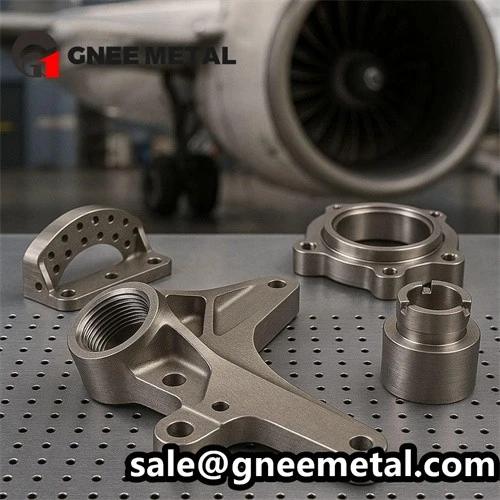


Titanium CNC Machined Parts
3-axis / 4-axis / 5-axis CNC machining
Grade 2, Grade 5, Grade 9, Grade 23
Prototype to production
Tight tolerances
Custom parts based on CAD drawings
Titanium CNC Machined Parts
We manufacture precision CNC machined parts from Titanium Grade 2, Grade 5 (Ti-6Al-4V), Grade 9 and other titanium alloys. CNC turning, milling and 5-axis machining are available for complex geometries, tight tolerances and small to production quantities.
Titanium Grades: Grade 2, Grade 5, Grade 9, Grade 23
Machining: CNC Turning, CNC Milling, 5-Axis CNC
Capabilities: Complex geometries, precision holes, threads, pockets and contours
Applications: Aerospace, marine, chemical processing, automotive and industrial equipment
Titanium CNC Machining Capabilities
| Capability | Specification / Details |
|---|---|
| CNC Turning | Titanium shafts, pins, bushings, sleeves, fittings and other cylindrical parts |
| CNC Milling | Plates, brackets, housings, blocks, flanges and parts with pockets, slots and threaded holes |
| 5-Axis CNC Machining | Complex 3D surfaces, angled features, deep cavities and multi-face machining in a single setup |
| Turn-Mill Machining | Combines turning and milling for shafts, fittings and complex rotational components |
| Part Size | Small precision components to larger custom machined parts; size based on machine capacity |
| Dimensional Tolerance | Standard CNC tolerances and tighter tolerances for critical features; capability confirmed during DFM review |
| Hole & Thread Machining | Through holes, blind holes, tapped holes, counterbores, countersinks and custom threads |
| Production Volume | Prototypes, low-volume batches, repeat production and higher-volume orders |
| CAD File Formats | STEP, STP, IGES, X_T, DWG, DXF and other common engineering formats |
| Material Grades | Titanium Grade 2, Grade 5 (Ti-6Al-4V), Grade 9, Grade 23 and specified titanium alloys |
Titanium Grades for CNC Machining
Different titanium grades offer different combinations of strength, corrosion resistance, weight and machinability. We machine commonly specified grades for industrial and high-performance applications.
| Titanium Grade | Key Properties | Typical CNC Machined Parts |
|---|---|---|
| Grade 1 | Lowest strength, excellent ductility and corrosion resistance | Thin-wall parts, chemical processing components, fittings |
| Grade 2 | Good strength, excellent corrosion resistance and relatively good machinability | Fittings, brackets, housings, shafts, marine components |
| Grade 5 (Ti-6Al-4V) | High strength-to-weight ratio, high strength and good fatigue performance | Aerospace parts, shafts, brackets, structural components |
| Grade 9 (Ti-3Al-2.5V) | Moderate strength, good ductility and corrosion resistance | Tubular components, lightweight fittings, aerospace parts |
| Grade 23 (Ti-6Al-4V ELI) | High strength, toughness and improved fracture resistance | Aerospace, high-performance and critical components |
How to Choose the Right Titanium Grade
| Requirement | Recommended Grade | Why |
|---|---|---|
| Maximum corrosion resistance with moderate strength | Grade 1 | Excellent corrosion resistance and ductility; suitable for low-stress components |
| General industrial corrosion resistance | Grade 2 | Higher strength than Grade 1 while maintaining excellent corrosion resistance; a practical choice for fittings, housings and marine parts |
| High strength + lightweight design | Grade 5 (Ti-6Al-4V) | Much higher strength than commercially pure titanium; widely used for aerospace, automotive and high-performance components |
| Balance of strength, ductility and formability | Grade 9 (Ti-3Al-2.5V) | Stronger than CP titanium grades while offering good ductility; suitable for lightweight tubular and structural components |
| High strength + improved toughness | Grade 23 (Ti-6Al-4V ELI) | Lower interstitial content provides improved ductility and fracture toughness for demanding applications |
| Chemical / marine environments | Grade 2 | Strong corrosion resistance makes it suitable for seawater and many chemical-processing environments |
| Aerospace structural components | Grade 5 / Grade 23 | High strength-to-weight ratio with good fatigue and mechanical performance |
| Low-load, thin-wall components | Grade 1 | Excellent ductility and corrosion resistance with relatively low material strength |
Quick Selection:
Grade 1 → corrosion resistance + ductility
Grade 2 → general industrial & marine use
Grade 5 → high strength + lightweight
Grade 9 → strength + ductility + formability
Grade 23 → high strength + toughness for demanding applications
Types of Titanium CNC Machined Parts

Titanium CNC Shafts

Titanium CNC Pins

Titanium CNC Bushings

Titanium CNC Brackets

Titanium CNC Fittings

Titanium CNC Housings

Titanium CNC Flanges

Custom Titanium Components
Titanium CNC Machining Processes
Titanium requires controlled cutting parameters, rigid workholding and appropriate tooling to manage heat and tool wear. We select the machining process according to part geometry, tolerance, material grade and production volume.
| Machining Process | Best For | Typical Titanium Parts |
|---|---|---|
| CNC Turning | Cylindrical and rotational components | Shafts, pins, bushings, sleeves, fittings |
| CNC Milling | Flat, prismatic and pocketed geometries | Brackets, plates, housings, flanges |
| 5-Axis CNC Machining | Complex 3D surfaces and multi-face features | Aerospace brackets, impellers, complex housings |
| CNC Turn-Mill | Parts combining turning and milling features | Complex shafts, connectors, fittings |
| Swiss CNC Machining | Small-diameter, high-precision components | Pins, miniature shafts, connectors, bushings |
| CNC Drilling & Tapping | Precision holes and threads | Mounting plates, flanges, housings, fittings |
How We Select the Process
Simple cylindrical part → CNC Turning
Prismatic part with pockets/holes → CNC Milling
Complex multi-face geometry → 5-Axis CNC
Rotational part with milled features → Turn-Mill
Small, long and precision parts → Swiss CNC
Titanium CNC Machining Tolerances & Specifications
We provide precision titanium CNC machining for components requiring controlled dimensional and geometric tolerances.
| Tolerance / Specification | Typical Capability |
|---|---|
| Linear Dimensions | ±0.02 mm for standard features; down to ±0.01 mm for selected critical dimensions |
| External Diameter (OD) | ±0.01–±0.02 mm for precision turned shafts and cylindrical features |
| Internal Diameter (ID) | ±0.01–±0.02 mm using precision boring or reaming |
| Hole Diameter | ±0.01–±0.02 mm for precision holes, depending on diameter and depth |
| Hole Position | Typically ±0.02–±0.05 mm for controlled mounting-hole locations |
| Thickness | ±0.02–±0.05 mm depending on material thickness and part geometry |
| Length / Width / Height | ±0.02–±0.05 mm for common machined dimensions |
| Flatness | Up to 0.02–0.05 mm on controlled mounting surfaces |
| Parallelism | Up to 0.02–0.05 mm between specified surfaces |
| Perpendicularity | Up to 0.02–0.05 mm between critical surfaces |
| Concentricity / Coaxiality | Up to 0.02–0.05 mm for selected cylindrical features |
| Thread Tolerance | Metric, UNC, UNF, NPT and custom threads; tolerance class specified per drawing |
| Chamfer / Radius | Typically ±0.05 mm |
| Surface Roughness | Ra 0.8–3.2 μm for typical CNC-machined surfaces; finer finishes available |
Titanium CNC Part Surface Finishes
Titanium CNC parts can be supplied with different surface finishes based on appearance, surface roughness, corrosion resistance and functional requirements.
| Surface Finish | Suitable Titanium Parts / Applications | |
|---|---|---|
| As Machined | Visible tool marks; typically Ra 1.6–3.2 μm | Shafts, pins, bushings, internal components |
| Polishing | Smooth, low-roughness surface with improved appearance | Fittings, visible components, precision parts |
| Bead Blasting | Uniform matte texture that hides machining marks | Housings, brackets, enclosures |
| Brushing | Directional satin texture | Covers, housings, visible equipment components |
| Passivation / Chemical Cleaning | Cleaned titanium surface with reduced surface contamination | Chemical, marine and corrosion-sensitive components |
| Anodizing | Controlled oxide layer with selectable colors and surface characteristics | Aerospace, decorative and identification components |
| Electropolishing | Very smooth, bright surface with reduced surface roughness | Small precision parts, fittings and components requiring enhanced cleanability |
Surface Roughness Options
Ra 3.2 μm - General CNC machining
Ra 1.6 μm - Precision machined surfaces
Ra 0.8 μm - Fine machining
Ra ≤0.4 μm - Polished / specially finished surfaces
Surface finish can be specified by Ra value, visual appearance or both. For critical sealing, sliding or mating surfaces, the required roughness and finishing process should be defined on the engineering drawing.
Titanium CNC Machining Quality Control


We control titanium CNC parts through material verification, in-process inspection and final dimensional inspection to ensure the finished parts meet drawing requirements.
| Quality Control Item | Inspection Method / Equipment | What We Check |
|---|---|---|
| Material Verification | Material certificate / PMI | Titanium grade, chemical composition and material traceability |
| Dimensional Inspection | CMM, calipers, micrometers | Length, width, thickness, diameters and critical dimensions |
| Geometric Inspection | CMM | Flatness, parallelism, perpendicularity, position and concentricity |
| Hole Inspection | Bore gauges, pin gauges | Hole diameter, depth and location |
| Thread Inspection | Go/No-Go gauges, thread gauges | Thread size, pitch and fit |
| Surface Roughness | Roughness tester | Ra value of specified surfaces |
| Visual Inspection | Magnification / visual inspection | Burrs, scratches, tool marks, dents and surface defects |
| Hardness Testing | Hardness tester | Material hardness when specified |
| Final Inspection | CMM + inspection checklist | Critical dimensions, tolerances, appearance and drawing compliance |
| Inspection Report | Dimensional inspection report | Recorded measurement results for customer review |
Titanium CNC Machined Parts Applications
Titanium CNC machined parts are used where high strength-to-weight ratio, corrosion resistance and long-term performance are important.
| Industry | Typical Titanium CNC Components | Common Grades |
|---|---|---|
| Aerospace | Structural brackets, mounting blocks, shafts, housings, fittings | Grade 5, Grade 23 |
| Automotive | Shafts, fasteners, brackets, valve components, lightweight structural parts | Grade 5, Grade 9 |
| Marine | Fittings, flanges, shafts, connectors, pump components | Grade 2, Grade 5 |
| Chemical Processing | Valve bodies, pipe fittings, flanges, pump components, adapters | Grade 2, Grade 7 |
| Industrial Equipment | Bushings, housings, brackets, precision shafts, machine components | Grade 2, Grade 5 |
| Robotics & Automation | Lightweight brackets, end-effectors, shafts, mounting components, housings | Grade 5, Grade 9 |
Why Titanium Is Used
High strength with low weight for lightweight structural components
Excellent corrosion resistance for marine and chemical environments
Good fatigue performance for moving and cyclic-load components
High temperature capability for demanding industrial applications
Long service life where conventional materials may corrode or add excessive weight
Titanium vs. Other CNC Materials
Titanium is typically selected when high strength-to-weight ratio, corrosion resistance and performance in demanding environments are more important than low material cost or easy machinability.
| Property | Titanium | Aluminum | Stainless Steel | Brass |
|---|---|---|---|---|
| Density | ~4.5 g/cm³ | ~2.7 g/cm³ | ~7.9–8.0 g/cm³ | ~8.4–8.7 g/cm³ |
| Strength-to-Weight Ratio | Excellent | Good | Good | Moderate |
| Corrosion Resistance | Excellent | Good | Excellent | Good–Excellent |
| Temperature Resistance | High | Moderate | High | Moderate |
| Machinability | Difficult | Excellent | Good–Moderate | Excellent |
| Material Cost | High | Low | Moderate–High | Moderate |
| Typical Advantage | Strength + low weight | Low weight + easy machining | Strength + corrosion resistance | Machinability + conductivity |
| Typical Applications | Aerospace, marine, chemical equipment | Aerospace, electronics, automation | Industrial equipment, automotive | Fittings, connectors, valves |
How to Choose
Choose Titanium when:
You need high strength without excessive weight
The component will operate in corrosive environments
High fatigue performance is important
Weight reduction is a major design requirement
The part is used in aerospace, marine or demanding industrial applications
Choose Aluminum when low weight, easy machining and lower material cost are the priorities.
Choose Stainless Steel when high strength, durability and corrosion resistance are required but titanium's weight advantage is not essential.
Choose Brass when excellent machinability, electrical conductivity or cost-effective production is more important than high strength-to-weight performance.
Packaging & Lead Time

Packaging
Individual Protection: Each titanium part can be wrapped separately with protective film or soft material.
Surface Protection: Finished and precision-machined surfaces are protected against scratches and handling damage.
Inner Packing: Foam, EPE, bubble wrap or compartment packaging keeps parts separated.
Outer Packing: Parts are packed in strong cartons or wooden cases according to size, weight and shipment method.
Custom Packaging: Special packaging is available for fragile, high-value or precision components.
Typical Lead Time
| Order Stage | Typical Lead Time |
|---|---|
| DFM Review & Quotation | 1–2 business days |
| Prototype Parts | 5–10 business days |
| Small-Batch Production | 7–15 business days |
| Repeat Production | 7–20 business days |
| Large / Complex Orders | Confirmed based on quantity and machining complexity |
FAQ
1. What titanium grades can you CNC machine?
We commonly machine Grade 1, Grade 2, Grade 5 (Ti-6Al-4V), Grade 9 and Grade 23 (Ti-6Al-4V ELI). Other titanium alloys can be considered based on the project requirements.
2. Is titanium difficult to CNC machine?
Titanium is more difficult to machine than aluminum or brass because of its low thermal conductivity, high cutting temperature and tendency to cause tool wear. Proper tooling, cutting parameters and coolant control are required.
3. What tolerances can you achieve on titanium CNC parts?
Typical dimensions can be controlled to ±0.02–±0.05 mm, with selected critical features achievable to around ±0.01 mm, depending on part geometry, size and machining process.
4. Can you provide 5-axis titanium CNC machining?
Yes. 5-axis CNC machining is available for complex titanium components with angled surfaces, deep cavities, multi-face features and complex 3D contours.
5. What titanium parts can you manufacture?
We manufacture shafts, pins, bushings, sleeves, brackets, fittings, flanges, housings and custom components according to customer drawings.
6. What surface finishes are available?
Depending on the titanium grade and application, options include as-machined, polishing, bead blasting, brushing, chemical cleaning and anodizing.
7. Can you provide material certificates for titanium parts?
Yes. Material certificates and material traceability documentation can be provided when required by the project.
8. What file formats do you accept?
We commonly accept STEP, STP, IGES, X_T, DWG and DXF files. 2D drawings with critical tolerances and specifications are also recommended.
9. What is the typical lead time?
Prototypes typically take around 5–10 business days, while small-batch production commonly takes 7–15 business days. Actual lead time depends on quantity, complexity, material availability and finishing requirements.
10. Can you manufacture titanium prototypes and small batches?
Yes. We support prototype, low-volume, repeat and production orders, allowing customers to validate designs before moving to larger quantities.
11. How do you inspect titanium CNC machined parts?
Inspection can include CMM measurement, micrometers, calipers, bore gauges, thread gauges, surface roughness testing and visual inspection. Inspection reports can be supplied for projects requiring documented dimensional results.
12. How can I get a quote for titanium CNC machined parts?
Send us your CAD file, titanium grade, quantity, tolerances, surface finish and delivery requirements. Our team will review the part and provide a quotation and production lead time.
Hot Tags: titanium cnc machined parts, China titanium cnc machined parts manufacturers, suppliers, factory, titanium
Previous
No InformationYou Might Also Like


Send Inquiry