


Why Brass Grade Selection Matters for CNC Machining
Brass is one of the most widely used materials for brass CNC machining thanks to its excellent machinability, corrosion resistance, and electrical conductivity. However, simply specifying "brass" on a drawing can lead to costly mismatches in performance, cost, and compliance across global supply chains.
Different brass alloys deliver drastically different results in chip control, surface finish, and mechanical strength. For engineers and procurement teams, choosing the right grade directly impacts production yield, tool life, and final part functionality.
This guide breaks down three of the most commonly specified grades - C36000 brass, H62 brass, and H65 brass - plus related alloy families, to help you make accurate, cost-effective material decisions.
The Free-Cutting Brass Family: C360 / HPb59-1 / C385
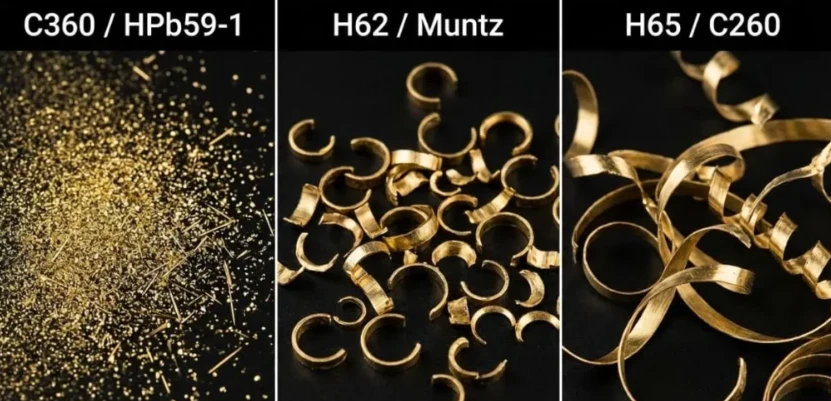
Free-cutting brasses are the workhorses of high-volume brass CNC turning and screw machine production. They contain controlled levels of lead that act as a lubricant during cutting, resulting in short, broken chips and minimal tool wear.
Core Composition and Machinability
The brass machinability rating of C36000 is set as the 100% benchmark against which all other metals are measured. This grade delivers consistent chip breaking even at high spindle speeds, making it ideal for complex, tight-tolerance parts.
| Alloy Grade | Standard Region | Lead Content | Machinability Rating | Typical Surface Finish |
|---|---|---|---|---|
| C36000 | US (ASTM) | ~2.5–3.7% | 100% (benchmark) | Ra 0.8–1.6 μm |
| HPb59-1 | China (GB) | ~0.8–1.9% | 80–90% | Ra 1.6–3.2 μm |
| C38500 | US (ASTM) | ~2.5–3.5% | 95% | Ra 1.6–3.2 μm |
Typical Applications
Free-cutting brasses are the first choice for high-volume brass screw machine parts, threaded components, and electrical connectors. They are also widely used for brass valve bodies where dimensional consistency and leak-tight threads are critical.
For projects requiring fast turnaround and low per-part cost, this family delivers the best overall machining economy.
Get a free C360 machining quote
The Structural & Marine Brass Family: H62 / C28000 / C46400
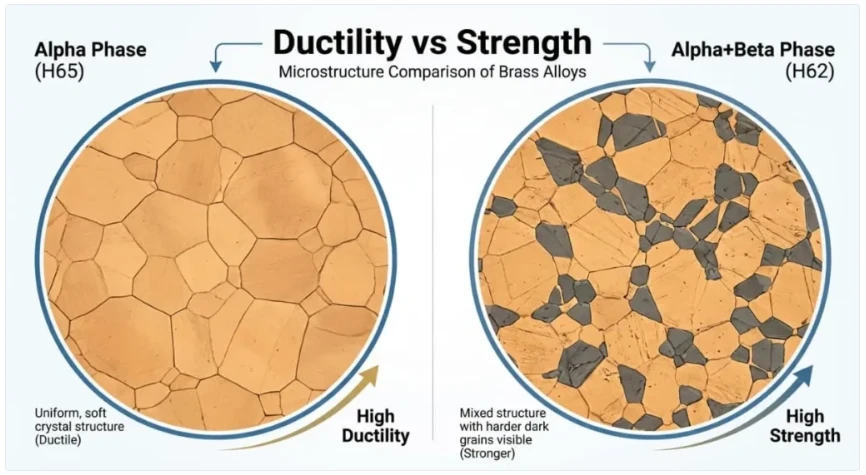
Structural and marine brasses balance higher strength with good corrosion resistance, making them suitable for load-bearing and outdoor or saltwater-exposed parts. They fall into the alpha-beta (duplex) brass category, which gives them improved mechanical properties over pure alpha grades.
H62 Brass Properties and Performance
H62 brass, also known as C28000 Muntz Metal in US standards, contains approximately 62% copper and 38% zinc. It offers higher tensile strength than free-cutting grades but has a lower machinability rating due to reduced lead content.
This grade is commonly used for structural brackets, fasteners, and general-purpose hardware where strength takes priority over maximum machining speed.
Naval Brass C46400 for Corrosion Resistance
Naval Brass C46400 adds tin to the alloy composition, significantly improving resistance to saltwater corrosion and dezincification. It is the go-to choice for marine brass hardware, shipboard components, and coastal infrastructure parts.
While naval brass machines well, it produces longer, more stringy chips compared to C36000, so tool geometry and chip breaker design must be adjusted accordingly.
For marine and offshore projects, working with a supplier experienced in marine CNC machined parts ensures proper material certification and corrosion performance.
The Cold Forming Brass Family: H65 / C26000
Cold forming brasses are highly ductile alpha-phase alloys designed for post-machining forming operations such as stamping, deep drawing, and bending. They are not optimized for maximum cutting speed, but they excel in applications that require deformation after machining.
H65 Brass Characteristics
H65 brass (equivalent to C26000 Cartridge Brass) contains about 65% copper and offers excellent ductility, good corrosion resistance, and a bright, polished surface finish. It is widely used for electronic components, decorative hardware, and parts that require brass deep drawing.
Because of its high ductility, H65 produces long, ribbon-like chips during machining. This can cause chip evacuation issues in high-volume brass CNC turning operations, especially on Swiss-type machines.
Machining Limitations and Best Practices
When machining H65, lower cutting speeds and specially ground chip breaker inserts are recommended to prevent built-up edge and stringy chip tangling. For complex small parts, Swiss CNC machining with high-pressure coolant delivery helps maintain tight tolerances and surface quality.
H65 is the preferred choice when a part requires both precision machined features and subsequent cold forming operations.
The Lead-Free Eco Brass Family: C69300 / RoHS Compliant Grades
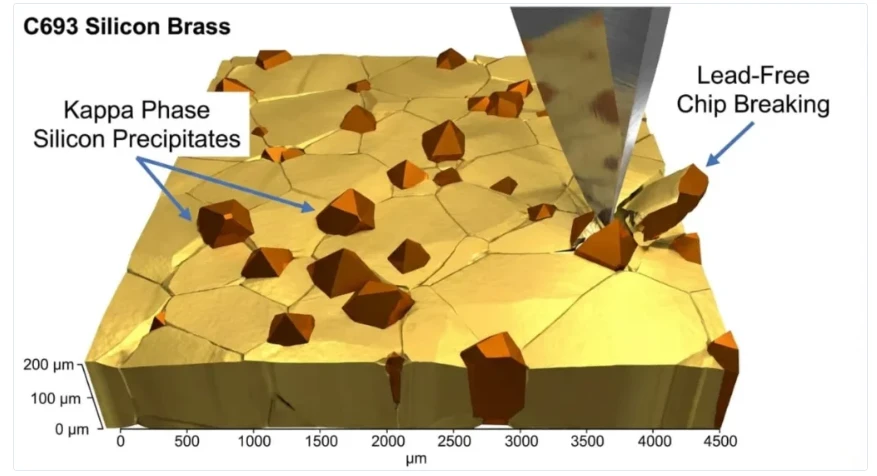
Regulatory pressure for RoHS compliant brass and lead-free components has driven rapid adoption of eco-brass alloys in consumer electronics, plumbing, and medical devices. These alloys replace lead with silicon or other elements to achieve good machinability without toxic additives.
C69300 Silicon Brass Performance
C69300 Silicon Brass is one of the most popular lead-free options. Silicon particles in the microstructure act as chip breakers, delivering machinability close to that of leaded brasses while meeting strict environmental regulations.
This grade also offers excellent corrosion resistance and high strength, making it suitable for plumbing fixtures, drinking water components, and electronics CNC machined parts that require RoHS compliance.
Compliance and Certification Considerations
For global supply chains, it is critical to verify that lead-free brass suppliers provide full material test reports and RoHS certificates. Misclassified or non-compliant material can result in product recalls and regulatory penalties.
Global Equivalent & Application Matrix
One of the biggest challenges in global sourcing is matching brass grades across different regional standards. The matrix below cross-references common US, Chinese, and European grades with key performance attributes and typical applications.
| US Grade | Chinese Grade | EU Grade | Machinability | Strength | Ductility | Primary Application |
|---|---|---|---|---|---|---|
| C36000 | HPb59-1 | CuZn36Pb3 | 100% | Medium | Low | High-volume turned parts, valves |
| C28000 | H62 | CuZn40 | 70% | High | Medium | Structural hardware, fasteners |
| C26000 | H65 | CuZn35 | 60% | Medium | High | Cold-formed electronics, connectors |
| C46400 | HSn62-1 | CuZn39Sn1 | 65% | High | Medium | Marine hardware, saltwater components |
| C69300 | HSi75-3 | CuZn31Si1 | 85% | High | Medium | Lead-free plumbing, RoHS parts |
This matrix helps engineering and procurement teams quickly identify equivalent materials when sourcing from manufacturers in different regions, reducing qualification time and minimizing material mismatch risks.
Expert Advice: How to Specify Brass for CNC Machining
Vague material specifications are the number one cause of unexpected cost overruns and performance issues in brass CNC machining projects. Follow these practical tips to ensure your supplier delivers exactly what you need.
Specify Full Grade Designation
Never write "brass" on a drawing. Always include the full standard grade number (such as C36000 or H62) along with the applicable standard (ASTM, GB, EN). This eliminates ambiguity and ensures consistent material sourcing across production runs.
Align Material with Manufacturing Process
Match the alloy to the primary manufacturing method. For example, choose free-cutting grades for high-volume CNC turned parts, and ductile grades for parts that require post-machining forming. Selecting the wrong grade can double machining time or cause part failure during secondary operations.
Balance Cost and Performance
While C36000 offers the lowest machining cost, it may not meet corrosion or compliance requirements. Conversely, premium lead-free or naval grades add cost that is unnecessary for indoor, non-critical applications.
Work with your machining partner early in the design phase to optimize material selection for both performance and total cost.
Consult our brass material engineering team
FAQ
Q: 1. What is the most machinable brass alloy?
A: C36000 free-cutting brass is the industry benchmark with a 100% machinability rating. It produces short, broken chips, extends tool life, and delivers the lowest per-part machining cost for high-volume production.
Q: 2. What is the difference between H62 and H65 brass?
A: H62 brass has higher zinc content (38%) and greater strength, making it suitable for structural parts. H65 brass has higher copper content (65%) and better ductility, making it ideal for cold forming and deep drawing operations.
Q: 3. Is C36000 brass RoHS compliant?
A: No, standard C36000 contains lead and is not RoHS compliant for most electronics and consumer product applications. For RoHS requirements, use lead-free alternatives such as C69300 silicon brass.
Q: 4. Can H62 brass be used in marine environments?
A: Standard H62 brass has moderate corrosion resistance but is not ideal for prolonged saltwater exposure. For marine applications, naval brass grades such as C46400 with added tin provide significantly better corrosion resistance.
Q: 5. What brass grade is best for CNC turning?
A: Free-cutting brasses like C36000 and HPb59-1 are the best choices for CNC turning due to their excellent chip control, high surface finish quality, and fast machining speeds.
Q: 6. What is lead-free eco brass?
A: Lead-free eco brass replaces lead with elements like silicon to achieve good machinability while meeting environmental regulations such as RoHS and drinking water standards. C69300 is a common example.
Q: 7. How does brass machinability compare to other metals?
A: Brass generally has better machinability than steel, stainless steel, and titanium. It runs at higher cutting speeds, produces better surface finishes, and causes less tool wear, resulting in lower overall manufacturing costs.
Q: 8. Can brass parts be used for high-strength applications?
A: Yes, alpha-beta brasses like H62 and naval brass offer good tensile strength and are suitable for many structural and load-bearing applications. For very high strength requirements, consult with your machining partner on grade selection.
Q: 9. What surface finishes are available for brass CNC parts?
A: Brass parts can be finished with polishing, plating, passivation, brushing, and powder coating. The choice of finish depends on the application, aesthetic requirements, and corrosion protection needs.
Q: 10. How do I choose between C360, H62, and H65?
A: Choose C360 for maximum machinability and lowest cost in high-volume production. Choose H62 for higher strength and structural applications. Choose H65 when ductility and cold forming capability are required.
Q: 11. What are common applications for brass CNC machined parts?
A: Common applications include valve bodies, connectors, fasteners, electrical components, plumbing fixtures, marine hardware, and decorative parts across automotive, electronics, and industrial sectors.
Q: 12. How can I verify brass material quality?
A: Always request material test reports (MTRs) from your supplier, and specify third-party inspection if required. Reputable manufacturers provide full traceability and certification for all raw materials.


