


Modern engineering teams face a universal precision paradox: complex, high-tolerance parts demand multiple setups, longer lead times, and higher costs-without sacrificing dimensional accuracy. 5-axis CNC machining services solve this by enabling one-operation production of intricate geometries, and China has emerged as a global hub for cost-effective, high-quality 5-axis solutions. This guide breaks down everything engineers and procurement teams need to know about sourcing 5-axis parts from China, from technical fundamentals to supplier selection.
Deep Dive: The Mechanics of True 5-Axis Precision
Limitations of 3-Axis Machining
Traditional 3-axis machining operates along X, Y, and Z axes, requiring manual repositioning of workpieces for multi-sided features. This leads to alignment errors, longer setup times, and higher labor costs for complex parts. For components with undercuts, curved surfaces, or angled holes, 3-axis processes often fail to meet tight tolerance requirements.
How 5-Axis Machining Works
5-axis machines add two rotational axes (typically A and B, or B and C) to the standard 3-axis setup, allowing the cutting tool or workpiece to rotate continuously during machining. This enables the tool to access all five sides of a part in a single setup, eliminating repositioning errors and reducing production time. True 5-axis capability delivers tight tolerance of ±0.005mm or better for complex geometries.
Common 5-Axis Machine Configurations
| Configuration Type | Rotational Axes | Best For | Key Benefit |
|---|---|---|---|
| Trunnion-style | A + C axes (workpiece rotates) | Medium-sized prismatic parts | High rigidity for heavy materials |
| Swivel head-style | B + C axes (tool head rotates) | Large, heavy workpieces | Flexible access to deep features |
| Gantry-style | Multiple rotational axes | Very large structural parts | High stability for aerospace components |
Simultaneous 5-Axis vs. 3+2 Axis (Indexed)
Many suppliers advertise "5-axis services" but only offer 3+2 indexed machining-understanding the difference is critical for sourcing success.
3+2 Axis Machining (Positional 5-Axis)
In 3+2 axis machining, the rotational axes lock the workpiece at a fixed angle before cutting begins, essentially performing 3-axis operations at set positions. This is ideal for simple angled features, flat multi-sided parts, and low-complexity components. It is more affordable than full 5-axis but cannot produce continuous curved surfaces.
Simultaneous 5-Axis Machining
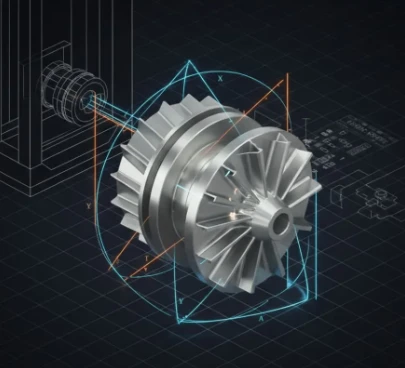
Simultaneous 5-axis machining moves all five axes in real time during cutting, enabling continuous, smooth machining of complex 3D contours like turbine blades, medical implants, and aerospace structural components. This process delivers superior surface finish, tighter tolerances, and faster cycle times for high-complexity parts.
How to Verify Supplier Capability
Ask suppliers for sample parts with continuous 3D surfaces, request live machine footage of simultaneous cutting, and confirm their CAM software supports 5-axis toolpath generation. Reputable Chinese suppliers will openly share their machine specifications and case studies.
Request a 5-axis capability audit
The Business Case: ROI and Total Cost of Ownership
While 5-axis machining has higher hourly rates than 3-axis, the total cost of ownership is often lower for complex parts.
| Cost Factor | 3-Axis Machining | 5-Axis Machining |
|---|---|---|
| Setup time | High (multiple repositionings) | Low (single setup) |
| Fixture cost | High (custom fixtures for each angle) | Low (universal fixturing) |
| Tool life | Shorter (longer tool reach needed) | Longer (optimal tool angle) |
| Scrap rate | Higher (alignment errors) | Lower (consistent accuracy) |
| Lead time | Longer (multiple operations) | Shorter (one-step production) |
For parts requiring 3+ setups on 3-axis machines, 5-axis services can reduce total costs by 20-40% while improving part quality. This makes it a cost-effective choice for aerospace, medical, and industrial automation applications.
The China Advantage in the Global Supply Chain
China's 5-axis CNC machining ecosystem offers unique benefits for global buyers, combining advanced technology with cost efficiency and supply chain resilience.
Advanced Hardware Infrastructure
Top Chinese machining facilities invest heavily in Tier-1 5-axis machines from brands like DMG MORI, Mazak, and Haas, ensuring consistent precision for high-complexity parts. Many shops operate 24/7 with automated loading systems to reduce lead times.
Integrated Supply Chain Ecosystem
China's dense network of material suppliers, surface finish providers, and secondary processing partners means faster turnaround for full-production parts. Buyers can source raw materials, machining, and finishing from a single supplier, simplifying project management.
Skilled Engineering Talent
Chinese 5-axis operators and CAM programmers undergo rigorous training, with many teams having decades of experience serving international clients in aerospace, medical, and automotive sectors. This expertise ensures smooth DFM feedback and minimal production delays.
For buyers in the aerospace sector, Chinese suppliers offer specialized expertise in aerospace components that meet strict industry standards.
Material Mastery in 5-Axis Machining
5-axis machining excels at processing difficult-to-machine materials, delivering consistent precision even for high-strength alloys. Below are the most common materials used in Chinese 5-axis services:
| Material | Key Properties | Common 5-Axis Applications | Machining Tip |
|---|---|---|---|
| Titanium grade 5 | High strength-to-weight ratio, corrosion resistance | Medical implants, aerospace parts | Use high-feed end mills with coolant |
| Stainless steel | Durable, corrosion-resistant | Food processing equipment, marine parts | Optimize spindle speed to avoid work hardening |
| Aluminum | Lightweight, high machinability | Electronics enclosures, automotive parts | Use high-speed machining for smooth finishes |
| Alloy steel | High tensile strength, wear resistance | Industrial equipment, hydraulic components | Use rigid tool holders to reduce vibration |
| Carbon steel | Cost-effective, versatile | Structural parts, brackets | Select appropriate feed rates for different hardness levels |
| Copper | Excellent electrical conductivity | Semiconductor components, electrical parts | Use sharp tools to prevent burrs |
| Brass | Low friction, corrosion-resistant | Fittings, valves, connectors | Use low cutting speeds for fine surface finishes |
Medical device buyers rely on 5-axis titanium CNC machined parts for precision implants that meet strict biocompatibility standards.
Design for Manufacturing (DFM) Masterclass
Optimizing your part design for 5-axis machining reduces costs, improves quality, and shortens lead times. Follow these key DFM guidelines:
1. Minimize deep, narrow features: Deep pockets with small corner radii require longer, thinner tools that are prone to deflection. Increase corner radii where possible to allow shorter, stiffer tools.
2. Avoid undercuts that require special tooling: While 5-axis can handle most undercuts, overly complex geometries may increase programming time and cost.
3. Maintain consistent wall thickness: Uneven wall thickness leads to material warping, especially for titanium and steel parts. Aim for uniform thickness across the part.
4. Consider part orientation: Design parts to maximize stability during 5-axis machining, reducing the need for custom fixturing.
Get free DFM feedback for your 5-axis part
Quality Assurance and E-A-T (Expertise, Authoritativeness, Trust)
Quality is the top concern for buyers sourcing CNC machining China services, and reputable Chinese suppliers invest heavily in rigorous inspection processes.
Core Inspection Methods
| Inspection Tool | Purpose | Tolerance Capability |
|---|---|---|
| CMM inspection (Coordinate Measuring Machine) | Dimensional verification of complex geometries | ±0.001mm |
| Optical comparator | 2D dimensional checks for flat parts | ±0.005mm |
| Surface roughness tester | Verify Ra values for surface finish | 0.02μm minimum |
| Hardness tester | Confirm material heat treatment results | Rockwell, Brinell, Vickers scales |
Industry Certifications
Top Chinese 5-axis suppliers hold internationally recognized certifications including ISO 9001 (quality management), AS9100 (aerospace), and ISO 13485 (medical devices). Always verify certification validity before partnering with a supplier.
IP Protection
Reputable Chinese suppliers offer strict IP protection agreements, secure file transfer systems, and restricted access to sensitive project data. Many have long-standing relationships with Western clients and prioritize data security.
The Buyer's Ultimate Checklist
Use this checklist to evaluate potential 5-axis CNC machining service providers in China:
| Evaluation Criterion | What to Verify |
|---|---|
| Machine capability | Confirm simultaneous 5-axis capacity, not just 3+2 |
| Material expertise | Check experience with your specific material (e.g., titanium grade 5) |
| Industry experience | Ask for case studies in your sector (aerospace, medical, etc.) |
| Quality systems | Verify relevant certifications and inspection equipment |
| DFM support | Confirm free design feedback before production |
| Lead time | Get clear timelines for prototyping and full production |
| Communication | Ensure responsive English-speaking support |
| IP protection | Review confidentiality agreement terms |
Get a custom 5-axis machining quote in 24 hours
FAQ
Q: 1. What is the difference between 5-axis and 3-axis machining?
A: 3-axis machining moves along X, Y, and Z axes only, requiring multiple setups for complex parts. 5-axis machining adds two rotational axes, allowing access to all five sides of a part in a single setup for faster production and tighter tolerances.
Q: 2. Is 5-axis machining more expensive than 3-axis?
A: While hourly rates are higher, 5-axis machining often reduces total costs by cutting setup time, fixture costs, and scrap rates. For parts requiring 3+ setups on 3-axis machines, 5-axis is typically more cost-effective.
Q: 3. What is the tolerance capability of Chinese 5-axis machining services?
A: Top Chinese suppliers can achieve tolerances as tight as ±0.005mm for 5-axis machined parts, with CMM inspection to verify accuracy. Tolerance limits vary by part geometry and material.
Q: 4. What materials can be machined with 5-axis processes in China?
A: Chinese 5-axis suppliers work with a range of materials including titanium grade 5, stainless steel, aluminum, alloy steel, carbon steel, copper, and brass.
Q: 5. How long does it take to get 5-axis machined parts from China?
A: Prototype parts typically take 7-15 days, while full production runs take 2-4 weeks depending on part complexity, material, and order quantity. Many suppliers offer expedited services for urgent projects.
Q: 6. What is the difference between 3+2 axis and simultaneous 5-axis machining?
A: 3+2 axis machining locks the workpiece at fixed angles for 3-axis cutting, while simultaneous 5-axis moves all axes continuously during cutting. Simultaneous 5-axis is needed for complex 3D contours like turbine blades.
Q: 7. Do Chinese 5-axis suppliers offer design support?
A: Yes, most reputable suppliers provide free DFM (Design for Manufacturing) feedback to optimize part designs for 5-axis machining, reducing costs and improving quality.
Q: 8. How do I ensure quality when sourcing 5-axis parts from China?
A: Work with suppliers that hold relevant certifications (ISO 9001, AS9100, ISO 13485), offer CMM inspection reports, and provide sample parts for evaluation before full production.
Q: 9. What industries commonly use 5-axis CNC machining services?
A: Key industries include aerospace, medical device, automotive, industrial automation, semiconductor, and marine. Common parts include turbine blades, medical implants, aerospace structural components, and hydraulic parts.
Q: 10. Can Chinese 5-axis suppliers handle both prototyping and mass production?
A: Yes, many top Chinese suppliers offer both low-volume prototyping and high-volume mass production, with scalable 5-axis capacity to meet changing project needs.
Q: 11. What is the minimum order quantity (MOQ) for 5-axis machining in China?
A: MOQs vary by supplier, but many Chinese shops accept orders as small as 1 piece for prototyping, with flexible scaling for production runs of 100+ parts.
Q: 12. How do I protect my intellectual property when working with Chinese 5-axis suppliers?
A: Choose suppliers with strict IP protection policies, sign non-disclosure agreements (NDAs) before sharing design files, and use secure file transfer systems for sensitive project data.


