


China machining services have become the backbone of global precision manufacturing, supporting industries from aerospace to consumer electronics with cost-effective, high-volume production capacity.

Many overseas buyers struggle to identify reliable CNC machining services China partners, facing hidden quality risks, communication gaps, and inconsistent lead times that disrupt production schedules.
This complete guide breaks down everything you need to know about sourcing precision parts from China, from core service types to supplier evaluation frameworks and risk mitigation strategies.
Get a Free CNC Machining Quote
Understanding China Machining Services in Today's Global Market
China machining services cover end-to-end precision manufacturing solutions, from prototyping and low-volume runs to high-volume production and secondary finishing operations.

Over the past decade, China's CNC manufacturing sector has upgraded from basic low-cost production to high-precision, automated production aligned with global industry standards.
Global buyers choose China CNC machining service partners for three core reasons: competitive pricing without sacrificing precision, scalable production capacity for fluctuating order volumes, and mature supply chains for fast material access.
Leading Chinese manufacturers serve clients across high-demand sectors, including aerospace CNC machining, automotive CNC machining, medical CNC machining, robotics CNC machining, and industrial automation CNC machining.
For industrial automation component needs, specialized suppliers deliver custom precision parts with strict dimensional consistency.
Types of CNC Machining Services in China
Chinese CNC manufacturers offer a full suite of precision machining services to match diverse part design requirements.
CNC Milling Services
CNC milling services use rotating multi-point cutting tools to remove material from a stationary workpiece, producing complex 3D shapes, slots, holes, and contoured surfaces.
This process is ideal for brackets, housings, plates, and custom mechanical components with irregular geometries.
CNC Turning Services
CNC turning services rotate the workpiece against a fixed cutting tool to create cylindrical parts such as shafts, pins, bushings, and fasteners with high concentricity.
Top cnc turning parts manufacturers offer both standard and high-precision turning for tight-tolerance rotational components.
5-Axis CNC Machining Service
5-axis CNC machining service enables cutting along five axes simultaneously, producing highly complex geometries with fewer setups and higher dimensional accuracy.
This process is widely used for aerospace turbine parts, medical implants, and robotics components with curved or undercut features.
Surface Finishing Services
Surface finishing services improve part appearance, corrosion resistance, wear resistance, and dimensional precision post-machining.
Common finishing options include anodizing, powder coating, polishing, passivation, and electroplating.
The table below summarizes core service features and typical use cases:
| Service Type | Key Capability | Typical Part Examples | Common Tolerance Range |
|---|---|---|---|
| CNC Milling | Complex 3D geometry | Brackets, housings, plates | ±0.02mm to ±0.1mm |
| CNC Turning | Cylindrical parts | Shafts, pins, bushings | ±0.01mm to ±0.05mm |
| 5-Axis Machining | Undercut & curved surfaces | Turbine blades, medical implants | ±0.005mm to ±0.02mm |
| Surface Finishing | Functional & aesthetic improvement | Anodized enclosures, polished shafts | Varies by process |
For custom milled component orders, verified suppliers provide full DFM (Design for Manufacturability) feedback early in the project.
How to Evaluate China CNC Machining Service Suppliers (Step-by-Step)
Selecting the right supplier is the most critical step to ensure consistent quality and on-time delivery for your China machining services project.
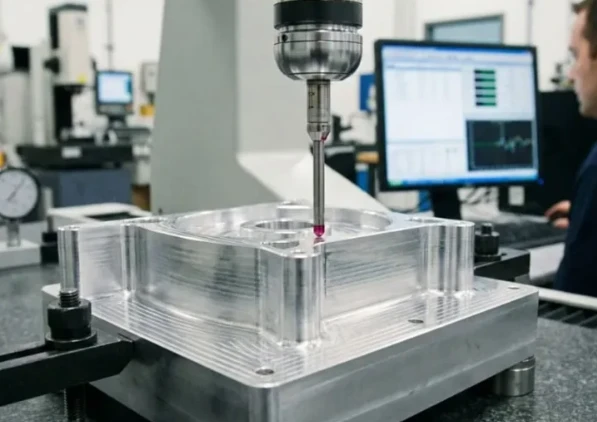
Follow this 4-step evaluation framework to vet potential partners systematically:
1. Verify production capacity and process coverage: Confirm the supplier offers the specific machining processes, material options, and order volume flexibility you need.
2. Audit quality management systems: Look for internationally recognized certifications such as ISO 9001, IATF 16949 for automotive, AS9100 for aerospace, and ISO 13485 for medical parts.
3. Assess communication and project management: Evaluate response speed, English proficiency, and whether the supplier assigns a dedicated project manager to your account.
4. Review inspection capabilities: Confirm the supplier has advanced testing equipment such as CMM (Coordinate Measuring Machine), optical comparators, and surface roughness testers.
The table below maps evaluation criteria to actionable verification methods:
| Evaluation Dimension | Core Check Items | Verification Method |
|---|---|---|
| Production Capacity | Process range, batch size flexibility | Request capability list and sample lead time |
| Quality System | Certifications, QC workflow | Review certificate copies and inspection reports |
| Communication | Response time, technical support | Send a test inquiry with technical requirements |
| Inspection Capability | Equipment types, tolerance measurement | Request equipment list and sample inspection data |
Request Supplier Capability Documents
CNC Milling vs CNC Turning: Which Do You Need?
Choosing between CNC milling services and CNC turning services depends primarily on your part's geometry, tolerance requirements, and production volume.
The table below compares the two processes across key decision factors:
| Comparison Factor | CNC Milling | CNC Turning |
|---|---|---|
| Primary Part Geometry | Prismatic, 3D, irregular shapes | Cylindrical, rotational parts |
| Typical Part Features | Slots, pockets, holes, contoured surfaces | Threads, tapers, grooves, concentric bores |
| Tolerance Capability | ±0.02mm standard, tighter for precision grades | ±0.01mm standard for small rotational parts |
| Ideal Batch Size | Prototyping to high volume | Low to high volume (high efficiency for cylindrical parts) |
| Setup Complexity | Higher for complex 3D parts | Lower for standard rotational parts |
For parts that combine both prismatic and rotational features, many suppliers offer combined mill-turn machining for one-stop production.
You can learn more about rotational part manufacturing options from dedicated process guides for precision turned components.
Materials Commonly Used in China Machining Services
Reliable China machining services suppliers offer traceable, certified metal materials to meet industry-specific strength, corrosion resistance, and weight requirements.
The table below covers the most commonly machined materials and their key applications:
| Material | Key Properties | Typical Industry Applications |
|---|---|---|
| Aluminum 6061 | Good strength, excellent machinability, corrosion resistance | Electronics enclosures, automation brackets |
| Aluminum 7075 | High strength-to-weight ratio, fatigue resistance | Aerospace structural parts, robotics components |
| Stainless Steel 304 | Good corrosion resistance, formability | Food equipment, medical device housings |
| Stainless Steel 316 | Superior corrosion resistance (salt water) | Marine components, chemical processing parts |
| Titanium | High strength-to-weight ratio, biocompatibility | Aerospace parts, medical implants |
| Brass | Excellent machinability, electrical conductivity | Connectors, fittings, valve components |
| Copper | High electrical/thermal conductivity | Electrical contacts, heat exchangers |
Reputable suppliers provide material certificates (MTC) for every batch, ensuring full traceability from raw material to finished part.
For high-strength, low-weight component requirements, specialized titanium machining partners deliver precision parts with strict material compliance.
Common Risks When Sourcing China Machining Services
While China machining services offer significant benefits, overseas buyers often face four common sourcing risks. Proactive mitigation strategies can eliminate most issues before they impact your project.
The table below outlines key risks and corresponding prevention measures:
| Sourcing Risk | Common Causes | Effective Mitigation Strategy |
|---|---|---|
| Dimensional non-conformity | Unclear tolerance specs, insufficient QC | Provide GD&T drawings, require first article inspection (FAI) |
| Delayed lead times | Underestimated capacity, supply chain gaps | Confirm production schedule upfront, build buffer time for first orders |
| Intellectual property leakage | Unsecured data sharing, unvetted suppliers | Sign NDAs before sending drawings, work with certified long-term partners |
| Hidden costs | Unquoted secondary operations, rework fees | Request detailed itemized quotes including finishing, inspection, and shipping |
Working with an experienced, transparent partner reduces these risks significantly by providing clear communication and standardized workflows from quote to delivery.
Discuss Your Project Risk Mitigation Plan
Why Work With a Professional China Machining Services Partner?
A professional China machining services partner acts as a long-term manufacturing extension of your team, not just a one-off supplier.
Unlike basic trading companies or small workshops, professional partners offer end-to-end support including DFM optimization, material selection guidance, and proactive quality control.
They also scale seamlessly with your business, supporting everything from initial CNC prototyping service runs to high-volume production with consistent quality.
For buyers in regulated industries such as aerospace and medical, certified partners ensure full compliance with industry standards throughout the production lifecycle.
Partner With Our Expert CNC Team
FAQ
Q: Are China machining services reliable for high-precision parts?
A: Yes, reputable Chinese CNC manufacturers produce high-precision parts with tight tolerance capabilities down to ±0.005mm, supported by advanced equipment and strict QC systems. Always verify certifications and request sample inspection reports before placing bulk orders.
Q: What is the typical lead time for CNC machining services China?
A: Standard lead times range from 3-7 days for prototyping, 10-20 days for low-volume production, and 20-45 days for high-volume orders. Lead times vary based on part complexity, material availability, and surface finishing requirements.
Q: How do I protect my design files when working with a china cnc machining service provider?
A: Sign a mutual non-disclosure agreement (NDA) before sharing any CAD drawings or design specifications. Work with established suppliers with documented IP protection policies and a track record of serving international clients.
Q: What tolerance grades can Chinese CNC suppliers achieve?
A: Standard machining tolerances range from ±0.05mm to ±0.1mm for general parts. High-precision processes can achieve tolerances of ±0.01mm to ±0.02mm for critical components, with 5-axis machining delivering even tighter precision for complex geometries.
Q: What industries do China machining services commonly serve?
A: Key sectors include aerospace CNC machining, automotive CNC machining, medical CNC machining, robotics CNC machining, industrial automation, electronics, marine, and semiconductor equipment manufacturing.
Q: Can I order small batch quantities from Chinese CNC suppliers?
A: Yes, most reliable suppliers support low-volume and prototype orders with no strict high MOQ requirements, making them ideal for startups, R&D teams, and custom component projects.
Q: What surface finishing options are available?
A: Common surface finishing services include anodizing, powder coating, sandblasting, polishing, passivation, electroplating, and heat treatment. Finishing options can be customized based on functional and aesthetic requirements.
Q: How do I handle quality issues with delivered parts?
A: Work with suppliers that offer clear return and rework policies. Always request first article inspection (FAI) reports for initial orders, and define acceptable quality limits (AQL) in your purchase agreement.
Q: What materials are most commonly machined in China?
A: The most widely machined materials include aluminum 6061, aluminum 7075, stainless steel 304, stainless steel 316, titanium, brass, and copper, with full material traceability and certification available from reputable suppliers.
Q: Do Chinese CNC suppliers provide design for manufacturing (DFM) support?
A: Yes, professional suppliers offer free DFM feedback to identify design flaws, reduce production costs, and improve part manufacturability before production begins.
Q: How do I choose between CNC milling and CNC turning for my part?
A: Use CNC turning for cylindrical, rotational parts such as shafts and pins. Use CNC milling for prismatic, 3D, or irregularly shaped parts such as brackets and housings. For parts with both features, combined mill-turn machining is often the most efficient option.
Q: What certifications should I look for in a China CNC supplier?
A: Look for ISO 9001 for general quality management, IATF 16949 for automotive parts, AS9100 for aerospace components, and ISO 13485 for medical device parts, depending on your industry requirements.


