


The Ultimate Guide to CNC Surface Finish: Function, Aesthetics & The Tolerance Trap
When engineers and procurement teams source CNC machined parts, surface finish is often treated as an afterthought. Yet it directly impacts part performance, service life, and final production cost.
Many buyers fall into the tolerance trap: specifying an unnecessarily fine surface finish that drives up cost and lead time, with no functional benefit. This guide breaks down how surface finish works, why it matters, and how to balance performance with cost.
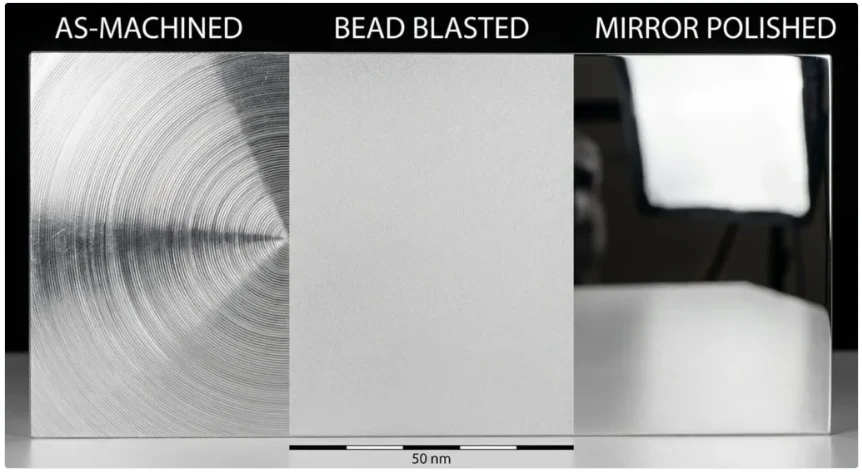
What Is CNC Surface Finish, and How Is It Measured?
Surface finish describes the texture, smoothness, and uniformity of a machined part's outer layer. It is most commonly quantified using Ra (arithmetic mean roughness), measured in micrometers (μm) or microinches (μin).
Lower Ra values indicate a smoother surface, while higher values mean a rougher, more textured finish. CNC machining processes leave characteristic tool marks that define the base Ra before any secondary finishing.
Common Ra Values and Typical Applications
| Ra Range (μm) | Common Finish Type | Typical Use Cases |
|---|---|---|
| 6.3 – 12.5 | Standard as-machined | Non-critical structural brackets, housings, frames |
| 1.6 – 3.2 | Fine machined | General mechanical parts, mounting surfaces |
| 0.4 – 0.8 | Precision ground | Sealing surfaces, bearing seats, precision shafts |
| 0.05 – 0.2 | Polished / mirror | Optical components, high-pressure seal faces |
Standard as-machined finishes are sufficient for most structural parts. Smoother finishes require additional processing steps, which add cost and extend lead times.
Functional Roles of CNC Surface Finish
Surface finish is far more than a cosmetic feature. It directly influences how a part performs in its operating environment, especially under load, motion, or corrosive conditions.
Wear Resistance and Friction Control
Smoother surfaces reduce friction between mating parts, extending service life in sliding or rotating assemblies. Rougher surfaces can cause premature wear, galling, and seizure in high-cycle applications.
For example, CNC machined shafts used in industrial gearboxes require controlled surface roughness to maintain lubricant film and prevent metal-to-metal contact.
Corrosion and Fatigue Resistance
Rough surfaces have more peaks and valleys where moisture, chemicals, and contaminants can accumulate. This accelerates corrosion and creates stress concentration points that reduce fatigue strength.
Parts exposed to harsh outdoor or marine environments benefit from smoother, uniform finishes paired with appropriate protective coatings.
Sealing and Fluid Retention
In hydraulic and pneumatic systems, surface finish directly affects seal effectiveness. Too rough, and the surface will wear down seals quickly; too smooth, and lubricant cannot adhere properly, leading to leakage.
CNC machined valve bodies and manifold components require tightly controlled surface finishes to maintain pressure ratings and prevent fluid loss.
Get a Surface Finish Consultation for Your Parts
Aesthetic Considerations for Visible Components
For consumer-facing or brand-displayed parts, surface finish contributes directly to perceived quality and product value. A consistent, clean finish signals precision and attention to detail.
Visible CNC machined housings for electronics and medical devices often receive brushed, bead-blasted, or anodized finishes to improve appearance while adding scratch resistance.
Aesthetic finishes also support branding goals, allowing for uniform color, texture, and logo placement across product lines.
The Tolerance Trap: Why Over-Specifying Hurts Your Budget
The tolerance trap occurs when buyers specify a surface finish far finer than the part's functional requirements demand. This is one of the most common and costly mistakes in CNC part sourcing.
How Surface Finish Drives Cost
Achieving smoother finishes requires additional operations such as CNC grinding, polishing, or lapping. Each extra step adds machine time, labor, and inspection overhead.
| Ra Target | Relative Cost Multiplier | Typical Process |
|---|---|---|
| 6.3 μm | 1x (baseline) | Standard milling / turning |
| 1.6 μm | 1.3 – 1.6x | Fine machining with optimized feeds |
| 0.4 μm | 2 – 3x | Grinding or precision machining |
| 0.1 μm | 4 – 8x | Polishing, lapping, or superfinishing |
Even a small reduction in Ra can double or triple the unit cost of a part, especially in medium to high production volumes.
How to Avoid the Trap
To avoid over-specifying, define the functional requirement first. Ask: does this surface slide, seal, carry load, or face the end user? If not, a standard as-machined finish is usually sufficient.
Work with your machining partner early in the design phase to align finish specifications with actual performance needs. Early DFM feedback can cut costs by 20–40% without sacrificing quality.
Request a DFM Review to Optimize Your Surface Finish Specs
Surface Finish by Material and Process
Different materials and CNC processes produce different baseline surface finishes. Understanding these baselines helps you set realistic expectations and choose the right manufacturing method.
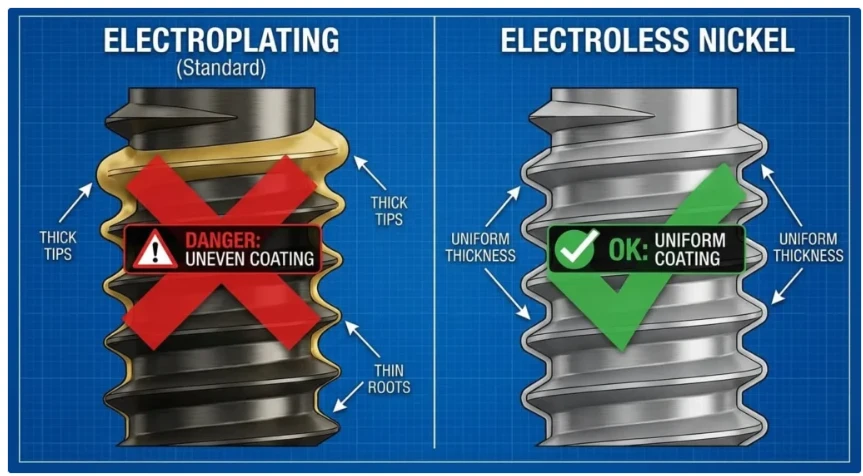
Baseline Finish by Material
| Material | Typical As-Machined Ra (μm) | Common Secondary Finishes |
|---|---|---|
| Aluminum | 1.6 – 3.2 | Anodizing, bead blasting, polishing |
| Brass | 0.8 – 3.2 | Polishing, plating |
| Copper | 1.6 – 6.3 | Polishing, plating |
| Stainless steel | 1.6 – 6.3 | Grinding, electropolishing, passivation |
| Carbon steel | 3.2 – 12.5 | Powder coating, plating, black oxide |
| Alloy steel | 3.2 – 12.5 | Grinding, heat treatment + finishing |
| Titanium | 3.2 – 6.3 | Polishing, anodizing |
Softer materials like aluminum and brass generally achieve better as-machined finishes than harder materials like titanium and alloy steel.
Baseline Finish by Machining Process
| Process | Typical Ra Range (μm) | Best For |
|---|---|---|
| CNC milling | 1.6 – 12.5 | Prismatic parts, brackets, plates |
| CNC turning | 0.8 – 6.3 | Round parts, shafts, bushings |
| Swiss CNC machining | 0.4 – 3.2 | Small, high-precision cylindrical parts |
| 5-axis CNC machining | 1.6 – 6.3 | Complex geometries with minimal setup |
| CNC grinding | 0.1 – 1.6 | Tight-tolerance sealing and bearing surfaces |
Process selection directly impacts achievable finish. For very smooth surfaces, grinding or specialized finishing operations are usually required.
How to Specify Surface Finish Correctly
Clear, accurate specification prevents miscommunication and ensures you receive parts that meet your needs at the right price.
Best Practices for Drawings and RFQs
- Mark only critical surfaces with specific Ra requirements
- Leave non-critical surfaces at the supplier's standard finish
- Note any cosmetic or functional requirements explicitly
- Include inspection method preferences if required
Providing a complete drawing with clear callouts reduces quotation time and minimizes the risk of costly rework.
Working With Your Machining Partner
A reliable CNC partner will review your specifications and flag any over- or under-specified finishes. They can recommend alternatives that balance performance, appearance, and cost.
Look for a supplier that offers in-house CNC surface finishing services so you can consolidate operations and reduce lead time.
Send Your Drawing for a Free Surface Finish Optimization Quote
FAQ
Q: 1. What is the most common surface finish for CNC machined parts?
A: The most common finish is standard as-machined, typically in the 3.2 to 6.3 μm Ra range. It is suitable for most structural and non-critical functional parts and offers the best balance of cost and performance.
Q: 2. Does a smoother surface finish always mean better quality?
A: No. A smoother finish is only better if the part's function requires it. For non-critical parts, specifying an overly smooth finish wastes budget and extends lead time with no practical benefit.
Q: 3. How does surface finish affect part cost?
A: Smoother finishes require additional machining, grinding, or polishing steps. Each extra operation adds time and labor, so cost increases significantly as Ra decreases. Very fine finishes can cost 4 to 8 times more than standard as-machined surfaces.
Q: 4. Can I get different surface finishes on different faces of the same part?
A: Yes. CNC machining allows selective finishing, so critical faces can be ground or polished while non-critical faces remain as-machined. This is a common way to optimize cost without sacrificing performance.
Q: 5. Which materials hold the best as-machined surface finish?
A: Aluminum and brass typically achieve the smoothest as-machined finishes due to their machinability. Harder materials like titanium and alloy steel usually require secondary operations to reach very low Ra values.
Q: 6. What is the difference between surface finish and surface texture?
A: Surface finish refers specifically to roughness, while surface texture is a broader term that includes roughness, waviness, lay, and flaws. In most CNC machining contexts, "surface finish" refers to Ra roughness.
Q: 7. How is surface finish inspected?
A: Surface finish is commonly measured using a profilometer, which drags a tiny stylus across the surface to calculate Ra values. Visual comparison samples are also used for less critical applications.
Q: 8. Does 5-axis machining produce a better surface finish than 3-axis?
A: Not inherently. 5-axis machining can produce smoother finishes on complex angled surfaces by maintaining optimal tool orientation, but the baseline Ra range is similar to 3-axis milling for flat geometries.
Q: 9. Can surface finish improve corrosion resistance?
A: Yes. Smoother surfaces reduce areas where moisture and contaminants can collect, slowing corrosion. Pairing a smooth finish with a protective coating further improves corrosion resistance.
Q: 10. What is the tolerance trap in CNC surface finish?
A: The tolerance trap refers to the common mistake of specifying a much finer surface finish than the part functionally needs. This drives up cost, extends lead time, and provides no measurable performance benefit.
Q: 11. How do I know if my surface finish spec is too tight?
A: If you cannot explain a clear functional or aesthetic reason for a specific Ra value, your spec is likely too tight. Consult your machining partner to review critical surfaces and recommend appropriate finish levels.
Q: 12. Can surface finish be adjusted after initial machining?
A: Yes. Secondary operations such as grinding, polishing, bead blasting, and coating can modify surface finish after machining. This allows you to start with a standard machined part and add targeted finishing only where needed.


