


If you're in the aerospace, marine, or chemical industries, you've likely encountered titanium rods as critical materials. The process of manufacturing titanium rods plays a crucial role in ensuring their quality and performance. In this guide, we'll walk you through how titanium bars are made, step by step, and explain why understanding this process matters to you.
Step 1: Raw Material Preparation
The first step in producing a titanium bar is preparing the raw materials. Titanium ingots-solidified and cast titanium alloy blocks-are typically used as the starting point. These ingots are then cut and shaped into more manageable forms, ready for further processing. The quality of the ingot directly impacts the final product, so this step is critical.
Step 2: Forging Process
Next, the titanium bar undergoes forging. This involves heating the titanium ingot to a specific temperature before deforming it into the desired shape. Forging is essential for improving the mechanical properties of the titanium bar, such as its strength and durability. There are two main types of forging to be aware of:
Hot Forging: The ingot is heated to high temperatures before being shaped. This process allows for better plasticity and higher processing efficiency.
Cold Forging: This is performed at room temperature, and because titanium has lower plasticity at these temperatures, greater force must be applied. While slower, cold forging is beneficial for creating intricate designs and fine-tuning material properties.
Step 3: Heat Treatment
After forging, the titanium rod undergoes heat treatment to relieve internal stress and further enhance its mechanical properties. Heat treatment typically includes two main processes:
Solution Treatment: The titanium bar is heated to a specific temperature, allowing alloying elements to dissolve uniformly into the titanium matrix. It is then rapidly cooled to stabilize the material.
Aging Treatment: Following solution treatment, the titanium bar is reheated to a lower temperature, held for a set period, and then cooled. This forms stable precipitates that increase the strength and hardness of the titanium bar.


Step 4: Machining for Precision
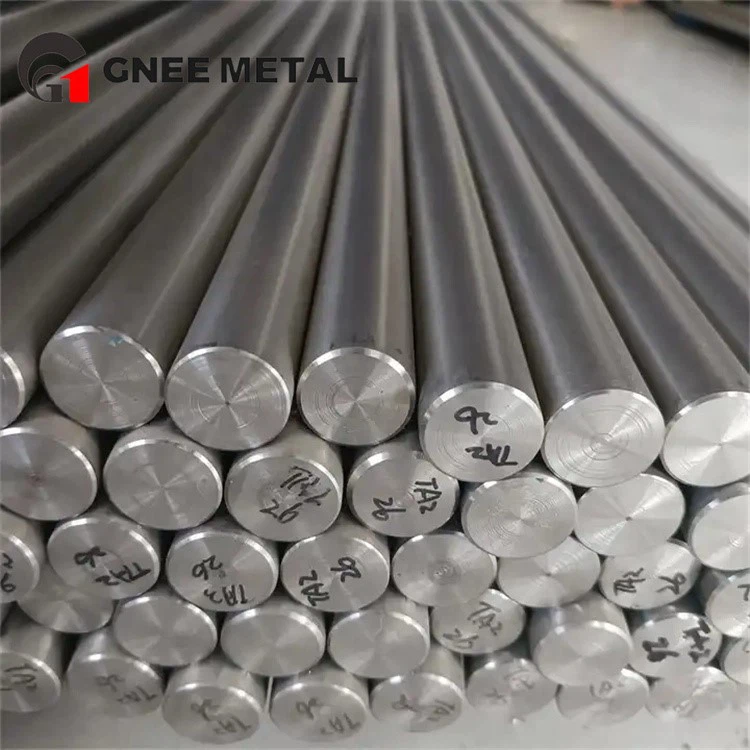
Once heat treatment is complete, the next step is machining. This involves various processes such as turning, milling, drilling, and grinding to achieve the precise dimensions and shape required for your titanium bar. Machining is essential for tailoring the titanium rods to your specific project requirements, whether for aerospace components, medical devices, or other applications.
Step 5: Surface Treatment
Finally, the titanium rod goes through surface treatment to improve its finish and corrosion resistance. Several processes are commonly used:
Pickling: The titanium bar is immersed in an acidic solution to remove oxidation and impurities from its surface.
Polishing: Mechanical or chemical methods are used to smooth out the surface of the titanium bar, providing a glossy finish.
Anodizing: By submerging the titanium rod in an electrolyte solution and applying an electrical current, a protective oxide layer forms on the surface. This not only enhances the corrosion resistance but can also give the titanium bar a distinct color.
Ensuring the Best Quality Titanium Bars
The process of making a titanium bar involves several critical stages, including raw material preparation, forging, heat treatment, machining, and surface treatment. Each of these steps must be carried out with precision to ensure that the final product meets your exacting standards. Whether you're looking for titanium rods for aerospace, marine engineering, or medical applications, the quality of your titanium bar depends on careful control of each process.
By following these detailed manufacturing steps and maintaining strict quality controls, titanium bars can achieve the performance characteristics required for demanding applications.
Discuss Your Project Requirements
Our product range
| Category | Product Name | Common Specifications (Available Upon Request) | Key Applications | |
|---|---|---|---|---|
| Titanium Tube | Seamless Titanium Tube Welded Titanium Tube |
ASTM B338 Gr1, Gr2, Gr5, Gr7, Gr9, Gr12 OD: 1mm - 300mm Wall Thickness: 0.5mm - 20mm Standards: ASTM, ASME, DIN, JIS |
Heat Exchangers, Condensers, Chemical Processing, Aerospace, Marine, Medical Implants | Get Free Sample & Evaluation |
| Titanium Sheet/Plate | Titanium Sheet Titanium Plate |
ASTM B265 Gr1, Gr2, Gr5, Gr7, Gr9, Gr12 Thickness: 0.1mm - 100mm Width: Up to 2000mm Conditions: Hot Rolled, Cold Rolled, Annealed |
Chemical Vessels, Pressure Vessels, Aerospace Structures, Marine Hardware, Architectural Cladding, Anodes | Get Free Sample & Evaluation |
| Titanium Bar/Rod | Titanium Round Bar Titanium Hexagon Bar Titanium Square Bar |
ASTM B348 Gr1, Gr2, Gr5, Gr7, Gr9, Gr12 Diameter/Section: 3mm - 300mm Length: As per requirement Forms: Forged, Rolled, Turned & Polished |
Fasteners, Valve Parts, Pump Shafts, Surgical Instruments, Sports Equipment, Automotive Components | Get Free Sample & Evaluation |
| Titanium Wire | Titanium Coil Wire Straight Titanium Wire Welding Wire |
ASTM B863 Gr1, Gr2, Gr5, Gr7, Gr9, Gr12 Diameter: 0.1mm - 10mm Forms: Annealed, Pickled Spool Weight: Customizable |
Welding Filler, 3D Printing (Wire Arc), Springs, Mesh, Medical Staples & Sutures, Fishing Tackle | Get Free Sample & Evaluation |
| Titanium Strip/Foil | Titanium Strip (Coil) Titanium Foil |
ASTM B265 Gr1, Gr2 Thickness: 0.03mm - 2.0mm Width: Up to 600mm Surface: Bright, Matte, Pickled |
Bellows, Gaskets, Honeycomb Structures, Heat Shields, Precision Instrument Parts, Battery Current Collectors | Get Free Sample & Evaluation |
Our factory
Our factory operates a dedicated production facility equipped with modern machinery for processing titanium. We have a complete set of equipment including forging presses, hot and cold rolling mills, tube drawing and welding lines, bar & wire drawing machines, and surface treatment units. This allows us to control the production process from raw material to finished products such as sheets, plates, tubes, bars, and wires. Our workshop is capable of handling large-volume orders while maintaining consistent quality across our product range.

Titanium product packaging
Our packaging is designed for maximum security and international standards. We use tailored wooden crates for heavy plates and bars, with internal waterproof wrapping and blocking to prevent movement. Tubes and coils are securely packed in wooden boxes with reinforced edges and protective end caps. For smaller items like wires and strips, we use standard export cartons with inner plastic and moisture-proof sealing. All packages are clearly marked with product details, weight, and handling instructions to ensure safe arrival. We can also customize packing methods, such as palletization or container optimization, based on specific shipping and customer requirements.

Discuss Your Project Requirements


