


What Is CNC Machining? The Definitive Guide for Engineers & Buyers
If you source precision metal parts for industrial products, you've likely encountered CNC machining as a core manufacturing process. But many engineers and procurement teams still struggle to align design intent with shop-floor capabilities, leading to delayed prototypes, unexpected costs, or inconsistent part quality.
This guide breaks down CNC machining from first principles to real-world production decisions, combining material science insights with hands-on manufacturing experience. Whether you're evaluating a new prototype or scaling a production run, you'll walk away with clear, actionable criteria for your next project.
The Core Principle: "Controlled Subtraction"
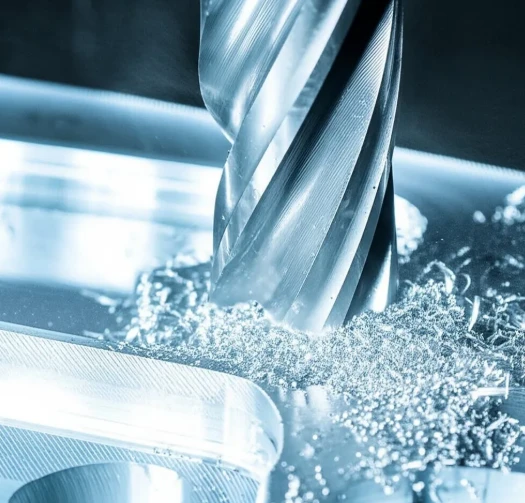
At its core, CNC machining is a form of subtractive manufacturing: it shapes solid stock material by removing excess material with rotating or cutting tools. Unlike additive processes that build parts layer by layer, subtractive methods deliver consistent, predictable mechanical properties across the entire part volume.
Material Science Perspective
Every cut generates shear stress at the tool-workpiece interface, where the tool shears away thin chips from the stock. Proper cutting parameters control this shear zone to avoid work hardening, surface damage, or excessive tool wear. This is why material-specific machining strategies are non-negotiable for high-quality results.
Shop-Floor Control Perspective
"CNC" stands for Computer Numerical Control, meaning every tool movement is dictated by programmed instructions rather than manual handwheels. This repeatability is what makes CNC machining suitable for tight-tolerance parts, from one-off prototypes to mid-volume production runs.
The CNC Workflow: From Art to Part
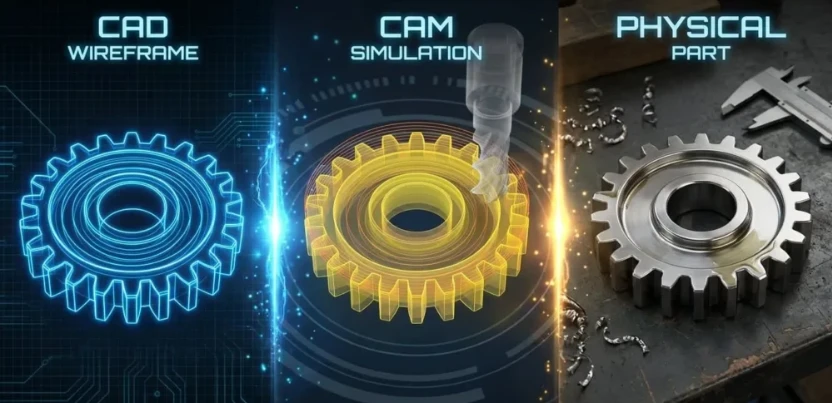
A reliable CNC workflow connects digital design to finished hardware through a structured, repeatable sequence. Skipping steps or cutting corners at any stage almost always shows up as dimensional errors, surface defects, or longer lead times.
CAD Model Preparation
The process starts with a 3D CAD model that defines every feature, tolerance, and surface requirement. Clean, fully defined geometry reduces ambiguity downstream and cuts programming time significantly.
CAM Programming
Machinists use CAM programming software to translate the CAD model into toolpaths: sequences of cuts that rough out excess material, finish critical features, and avoid collisions between the tool, fixture, and machine structure.
G-Code Generation
The CAM output is post-processed into G-code, the standardized language that CNC machines read to control spindle speed, feed rate, tool changes, and axis movement.
Setup and Fixturing
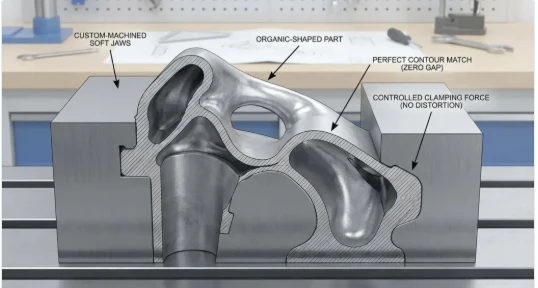
Operators secure the raw stock in the machine, often using custom soft jaws for irregular shapes or fragile parts. Proper fixturing prevents deflection during cutting, which is essential for holding tight tolerances.
Machining and Final Inspection
After running the program, parts undergo dimensional checks including CMM verification for critical features, plus visual and surface finish inspection before shipment.
Types of CNC Machines: Picking the Right Tool
Choosing the right machine type directly impacts part quality, lead time, and cost. Below is a comparison of the most common CNC processes used in precision metal manufacturing.
| Process | Typical Geometry | Key Advantage | Common Use Case |
|---|---|---|---|
| CNC Milling | Prismatic shapes, pockets, slots, 3D surfaces | Versatile for most mechanical parts | Brackets, housings, manifolds |
| CNC Turning | Round, cylindrical parts | Fast material removal on rotational features | Shafts, pins, bushings, spacers |
| Drilling | Holes, tapped features | High precision for fastener interfaces | Mounting plates, flanges |
| 3-Axis CNC | Parts accessible from 3 sides | Lower setup cost, wide material compatibility | Standard mechanical components |
| 5-Axis CNC | Complex 3D contours, undercuts | Fewer setups, better surface finish on angled features | Aerospace structures, turbine components |
| Swiss Lathes | Small, slender precision parts | Extreme concentricity and tight tolerances | Medical connectors, electronic pins |

For parts that combine rotational and prismatic features, turn-mill machines deliver both operations in a single setup. You can learn more about these capabilities in our overview of CNC turn-mill machined parts.
Materials: The Foundation of Quality
Material selection is the first and most impactful decision in any CNC machining project. The right material balances mechanical performance, corrosion resistance, machinability, and cost.
| Material | Key Properties | Common Applications | Machining Note |
|---|---|---|---|
| Aluminum | Lightweight, good strength-to-weight ratio, excellent machinability | Electronics enclosures, automation brackets | Fast cutting speeds, high chip load tolerance |
| 6061 aluminum | Balanced strength and formability | General-purpose structural parts | Widely used for prototypes and production |
| 7075 aluminum | High strength, near-steel strength-to-weight | Aerospace structural components | Lower machinability than 6061, requires sharp tools |
| Stainless Steel | Excellent corrosion resistance, good strength | Food equipment, marine parts, medical devices | Lower thermal conductivity, needs rigid fixturing |
| Carbon Steel | High strength, low cost, good hardness | Industrial equipment, gears, shafts | Prone to rust; often coated post-machining |
| Titanium | High strength-to-weight, extreme corrosion resistance | Aerospace, medical implants | Low thermal conductivity, high tool wear |
| Copper | Excellent electrical and thermal conductivity | Electrical connectors, heat sinks | Soft, gummy material; sharp tools reduce burrs |
| Brass | Good machinability, corrosion resistance, aesthetic finish | Fittings, valves, decorative hardware | Free-machining grades run at high speeds |
For aerospace-grade projects requiring high strength and light weight, titanium CNC machined parts are often the preferred choice.
CNC Machining vs. 3D Printing: The Honest Comparison
The CNC vs 3D Printing debate comes up frequently in prototyping and low-volume production. Each process has clear strengths, and the right choice depends on your part's function, volume, and performance requirements.
Structural Performance
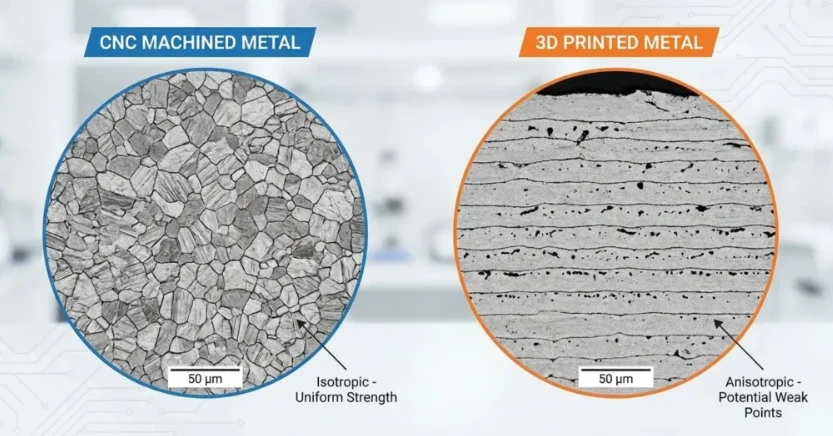
CNC machined parts are cut from solid stock, so they have fully isotropic CNC parts properties: strength is consistent in all directions. 3D printed parts, by contrast, are built layer by layer and often have weaker interlayer bonding, especially in load-bearing applications.
Precision and Surface Finish
CNC machining routinely holds tolerances down to ±0.005 mm or tighter, with smooth, controlled surface finishes. 3D printing can achieve fine detail but typically requires secondary machining or polishing to match CNC-level surface quality and dimensional accuracy.
When to Choose Each
- Choose CNC for functional components, tight-tolerance fits, and production parts requiring consistent material properties.
- Choose 3D printing for highly complex geometries with internal channels, very low volume concept models, or designs where assembly consolidation outweighs strength requirements.
Get a CNC vs. 3D Printing Feasibility Check
Limitations: When NOT to Use CNC
While CNC machining is extremely versatile, it is not always the optimal choice. Understanding CNC machining limitations upfront helps you set realistic expectations and avoid unnecessary costs.
1. Highly complex internal geometries: Undercuts, deep internal cavities, or intricate lattice structures are difficult or impossible to machine with standard tool access.
2. Very low-volume concept models: For non-functional visual prototypes, additive methods may be faster and cheaper.
3. Material waste: Subtractive processes remove material from solid stock, generating scrap. For very expensive materials, this can add significant cost.
4. Setup cost for one-offs: Custom fixturing and programming time make single-part runs relatively expensive per unit compared to higher volumes.
For projects where CNC is the right fit, precision CNC parts remain the gold standard for performance-critical applications across aerospace, automotive, and industrial automation.
Real-World Applications of CNC Machining
CNC machining powers critical components across nearly every industrial sector. A few common use cases include:
| Industry | Typical CNC Parts | Key Requirement |
|---|---|---|
| Aerospace | Structural brackets, turbine components, hydraulic manifolds | High strength, tight tolerances, material traceability |
| Automotive | Engine components, transmission parts, sensor housings | Dimensional consistency, wear resistance |
| Industrial Automation | Linear motion parts, machine frames, end-of-arm tooling | Rigidity, repeatable fit |
| Electronics | Heat sinks, connector pins, enclosure frames | Thermal/electrical conductivity, fine feature detail |
| Semiconductor | Wafer handling parts, test fixtures | Ultra-precision, low particle generation |
For high-reliability aerospace components, manufacturers rely on dedicated processes for aerospace CNC parts that meet strict industry standards.
Conclusion: Start Your CNC Machining Journey
CNC machining is the backbone of modern precision manufacturing, delivering unmatched accuracy, repeatability, and material performance for functional metal parts. From initial CAD model design through final CMM verification, every step in the process contributes to part quality and long-term reliability.
Whether you're developing an AL6061-T6 prototype, scaling Stainless Steel 304 production parts, or evaluating a new material for a high-performance application, working with an experienced CNC partner reduces risk and accelerates time to market.
Request Your Custom CNC Machining Quote
FAQ
Q: 1. What is CNC machining?
A: CNC machining is a subtractive manufacturing process that uses computer-controlled cutting tools to shape solid stock material into precise parts. It is widely used for high-precision metal components across industrial sectors.
Q: 2. What is the difference between CNC milling and CNC turning?
A: CNC milling uses rotating cutting tools to remove material from a stationary workpiece, ideal for prismatic shapes. CNC turning rotates the workpiece against a fixed tool, used for cylindrical parts like shafts and pins.
Q: 3. What is 5-axis CNC machining used for?
A: 5-axis CNC machining moves the workpiece or tool across five axes simultaneously, enabling complex 3D contours, angled features, and undercuts in fewer setups. It is commonly used for aerospace and medical components.
Q: 4. What materials can be CNC machined?
A: Common CNC machinable metals include aluminum, stainless steel, carbon steel, titanium, copper, and brass. Each material has specific machinability characteristics and ideal use cases.
Q: 5. How accurate is CNC machining?
A: CNC machining can hold tolerances as tight as ±0.005 mm for precision parts, depending on material, machine capability, and part geometry. Final accuracy is verified through methods like CMM inspection.
Q: 6. What is G-code in CNC machining?
A: G-code is the standardized programming language that controls CNC machine movements, including spindle speed, feed rate, tool changes, and axis positioning. It is generated from CAM software based on the CAD model.
Q: 7. Is CNC machining better than 3D printing?
A: It depends on the application. CNC machining offers superior strength, isotropic properties, and precision for functional parts. 3D printing is better for highly complex geometries and very low-volume concept models.
Q: 8. What are the main limitations of CNC machining?
A: CNC machining is less suitable for highly complex internal geometries, very low-volume non-functional prototypes, and projects where minimal material waste is critical. Setup costs can also be higher for one-off parts.
Q: 9. What is the CNC workflow from design to finished part?
A: The typical CNC workflow includes CAD modeling, CAM programming, G-code generation, machine setup and fixturing, machining operations, and final inspection including dimensional and surface finish checks.
Q: 10. What surface finishes are available for CNC machined parts?
A: CNC parts can be supplied in as-machined condition or with secondary surface finishes including anodizing, powder coating, polishing, bead blasting, and passivation, depending on the material and application.
Q: 11. What is a CNC endmill used for?
A: A CNC endmill is a rotating cutting tool used in milling operations to remove material and create features like pockets, slots, contours, and flat surfaces. Different endmill geometries are optimized for different materials and cut types.
Q: 12. How do I choose the right CNC machining partner?
A: Look for a partner with experience in your industry, strong quality inspection processes, transparent communication, and the ability to support both prototyping and production scaling. Material expertise and DFM support are also critical.


