


Input Costs, Week Of November 2, 2026
| Material | USD / kg | vs. Oct 26 | What it means for your quote |
|---|---|---|---|
| 6061-T6 aluminium | 4.94 | +0.09 / +1.86% | Third consecutive gain. Aluminium is 55–65% of a housing's metal cost |
| 7075-T6 aluminium | 5.62 | +0.10 / +1.81% | Aerospace-driven; harder to source in non-stock sizes |
| 1018 carbon steel | 1.29 | +0.01 / +0.78% | Flat. Cheapest structural option |
| 4140 alloy steel (annealed) | 1.43 | +0.01 / +0.70% | Flat |
| 304 stainless | 4.18 | +0.03 / +0.72% | Slow cutting, high tool cost - metal is not the driver |
| 316L stainless | 5.72 | +0.04 / +0.70% | - |
| 17-4PH stainless | 8.30 | +0.06 / +0.73% | Add a heat-treat operation and its queue |
| C36000 free-cutting brass | 8.55 | −0.05 / −0.58% | Copper decline passing through, 2–4 weeks late. November brass quotes are the softest in six weeks |
| C11000 copper | 16.11 | −0.09 / −0.56% | Swarf credit is real here - see the rejection section |
| Titanium Gr2 bar | 22.02 | +0.61 / +2.85% | Second consecutive sponge round |
| Titanium Gr5 bar | 35.10 | +1.27 / +3.75% | Largest single material move in the table |
| Machine hour, 3-axis | 32 | unchanged | - |
| Machine hour, 4-axis | 46 | unchanged | - |
| Machine hour, 5-axis | 78 | unchanged | 2.4× a 3-axis hour; only worth it when it removes setups |
| Machine hour, mill-turn | 52 | unchanged | - |
| Machine hour, wire EDM | 58 | unchanged | Slow - price by length of cut, not by parts |
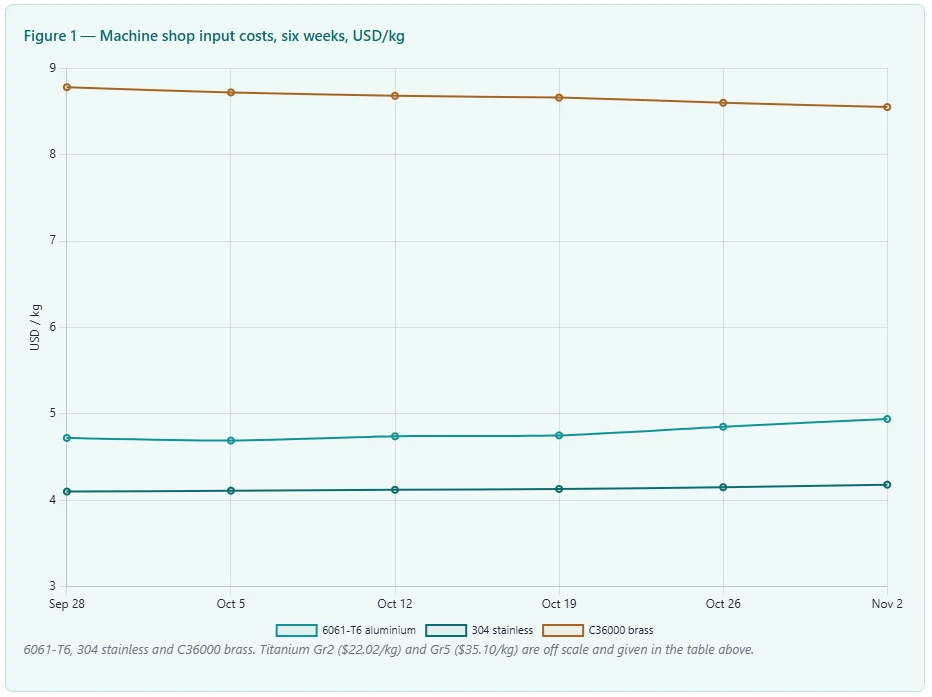
Read that table once and then set it aside, because on a typical machined part material is 12 to 22% of the piece price. A 1.86% move on 6061-T6 shifts a $25.10 part by about two cents. Everything below moves it by dollars.
The running example. Part 1472 - a 6061-T6 sensor housing, 96 × 64 × 28 mm, 4-axis, clear Type II anodize, laser mark. Annual 600 pieces released as two lots of 300. Quoted $25.10 per piece at 300. Every figure in this piece is calculated against it.
Leak 1 - The Engineering Change: $0 Or $7,530 From The Same Revision
A revision is not priced by how big it is. It is priced by how much of the shop's work it invalidates. Here is the ladder, worked on Part 1472 at 300 pieces.
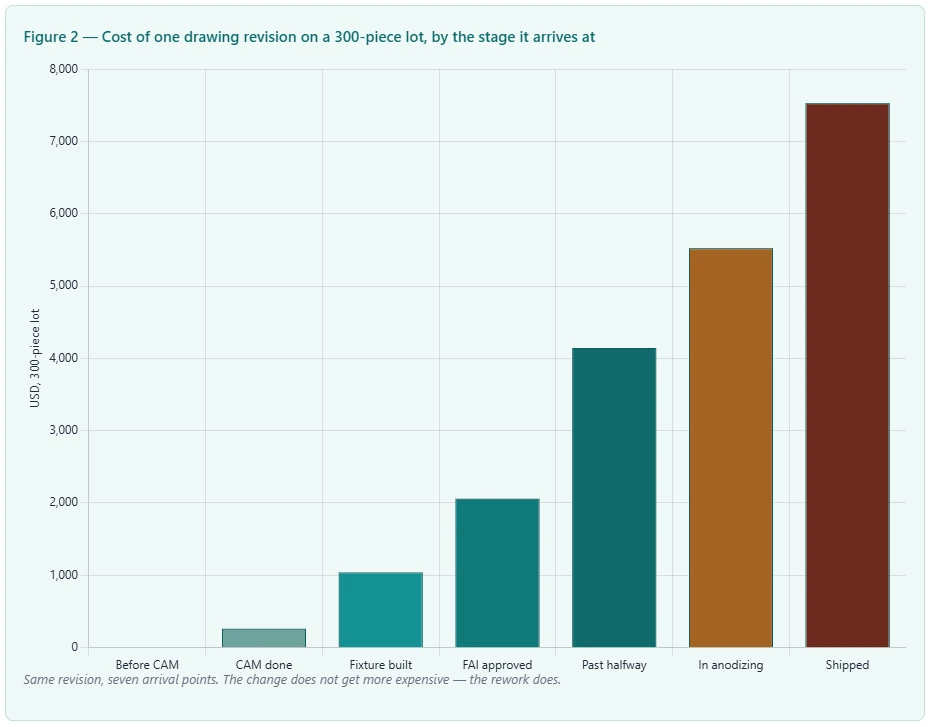
| Stage the change arrives | What has to be redone | Cost | Per part | Calendar delay |
|---|---|---|---|---|
| Before CAM released | Nothing. The revision goes into the program as written | $0 | $0.00 | 0 days |
| Programming complete, no stock cut | Re-CAM and re-verify | $260 | $0.87 | 2–3 days |
| Fixture built, no first article | Re-CAM plus fixture modification or rebuild | $1,040 | $3.47 | 6–9 days |
| First article approved, under 20% run | Above, plus scrap of 55 half-built parts at $14.20, plus re-FAI | $2,060 | $6.87 | 10–14 days |
| Past halfway through production | Above, plus scrap of 170 half-built parts, plus line re-sequencing | $4,144 | $13.81 | 15–21 days |
| Lot is in anodizing | Above, plus strip and re-anodize all 300 at $4.60 | $5,524 | $18.41 | 18–25 days |
| Already shipped | Full re-make plus return freight and re-import | $7,530 | $25.10 | Full lead time again |
The failure mode is predictable and it is a buyer behaviour, not a shop behaviour. Someone notices the fit problem on day 4, decides not to "disrupt the schedule", and sends the revision on day 21 - by which point the shop is past halfway and the same piece of information costs $4,144 instead of $260. Telling the shop early never makes a programme later; it is the only thing that makes it cheaper.
The Two Clauses That Close This
Require a first-article gate. Specify that production does not start until you sign off the FAI report and dimensioned photos. The gate costs $240 on Part 1472. It is what lets you catch a fit problem at stage 4 ($2,060) instead of stage 7 ($7,530). $240 to avoid up to $5,470.
Authorise the shop to stop. Write into the PO that on receiving any revision the shop will notify you within 24 hours with a cost and schedule number, and will hold work until you respond in writing. Without this clause the shop has two bad options - guess, or keep running into the scrap - and it will pick the one that keeps its schedule, which is not the one that protects your budget.
Freeze the print for the lot. Any change that is not a safety or fit-blocking issue goes on the next lot. On a 600-per-year part released twice, the wait is 26 weeks on paper and about 8 weeks in practice.
Leak 2 - Fourteen Operations Quoted As "Included" And Billed Later
Machine shops quote machining accurately. Finishing is where the estimate goes soft, partly because much of it is subcontracted and partly because it is quoted as a single word - "anodize", "passivate", "plate" - when it is really a list of separate charges. Below is what each one actually costs, and the dimensional change it imposes on the part.
| Operation | Lot minimum | Per piece | What "included" usually hides |
|---|---|---|---|
| Anodize, Type II clear | $85–145 | $1.40–2.60 | Rack contact marks; masking of threads and bores is extra |
| Anodize, Type II black | $110–180 | $1.90–3.40 | Dye-lot colour drift between lots - specify a retained reference chip |
| Anodize, Type III hard | $150–260 | $3.20–6.50 | Adds 0.005–0.013 mm per surface. Shafts and bores must be machined undersize or oversize to suit |
| Chemical film (chromate conversion) | $75–130 | $0.85–1.70 | RoHS-compliant versus hex-chrome - the cheap one may be non-compliant |
| Passivation, stainless (ASTM A967) | $95–160 | $1.10–2.30 | Citric versus nitric; no verification test is run unless you name one (A967 Practice A or the salt-spray option) |
| Electropolish | $180–320 | $2.60–5.80 | Removes 0.008–0.025 mm - tolerance stacks change after deburr |
| Black oxide, steel | $70–120 | $0.75–1.60 | No corrosion protection on its own - needs oil or sealer, usually not quoted |
| Zinc plating | $85–150 | $0.95–2.20 | Hydrogen embrittlement relief bake on anything above HRC 32 - omitted by default and it is a real failure mode |
| Electroless nickel | $140–260 | $2.40–5.20 | Uniform thickness is the selling point; masking is billed separately |
| Powder coat | $120–220 | $2.20–4.80 | Adds 0.08–0.15 mm. Every thread, bore and grounding surface must be masked or re-tapped |
| Heat treat (solution and age, T6) | $130–280 | $1.80–4.20 | Distortion - budget for a straightening or a post-HT finish pass |
| Stress relieve | $90–180 | $0.90–2.00 | Often the cheapest way to hold flatness on thin plates |
| Laser mark or engrave | $60–120 setup | $0.35–1.20 | Program setup is charged separately from the per-piece rate |
| CMM full layout report | $180–450 | - | Must say per lot or per piece. If it is not a PO deliverable you will pay to get it later |
Two structural consequences follow, and both are easy to miss at quote stage.
Lot minimums invert the economics on small quantities. On a 20-piece order, a $145 anodize minimum is $7.25 per piece before the tank is even switched on. At 300 pieces it is $0.48. Finishing, not machining, is what makes small lots expensive - and it is why consolidating two small releases into one is almost always the cheapest move available to a buyer.
Every coating changes the part's dimensions. Hard anodize grows a surface by 5 to 13 microns, powder coat by 80 to 150 microns. If the print calls out ±0.05 mm on a shaft that gets hard anodized, the parts will not assemble - and the shop will correctly say the machined dimension was in tolerance. Name the coating on the print and state whether the tolerance applies before or after finishing. This single line prevents a class of dispute that is otherwise unwinnable after the fact.
Leak 3 - Machining Is 3 Of 34 Days. The Rest Is Queue
The most common expedite request is "run my parts overtime". It is almost always the wrong lever, because overtime compresses the three days that are actually cutting metal and does nothing about the thirty-one days that are not.

| Stage | Days | Can it be compressed? | What compression costs |
|---|---|---|---|
| Quote and order entry | 1.5 | No | - |
| Material procurement (non-stock size) | 4 | Yes | Ex-stock or air: +$0.40–1.20/kg. Or use a stock size and save the wait free |
| CAM programming | 3 | Yes | Overtime programmer: +$180–420 |
| Fixture build | 5 | Yes | +$260–700 |
| Machine queue | 7 | Yes - this is the real bottleneck | Queue jump means displacing another job: +15–35% on machine time |
| Machining run | 3 | Partly | Second or third shift: +12–25% |
| Deburr and edge finish | 2 | Yes | +$0.35–1.10/pc |
| FAI and inspection | 2 | Yes | +$120–320 |
| Anodize at an outside vendor | 5 | Partly | Outside vendor rush: +50–100% of the anodize lot charge |
| Pack and ship | 1.5 | Partly | Air freight |
Add it up and machining is 9% of the calendar. The other 91% is waiting - waiting for material, waiting for a machine, waiting for a vendor's tank. So the two levers that actually work are not the ones buyers reach for:
Reduce the number of external operations. Every outsourced step adds its own queue, and an outside vendor's queue averages 5 to 9 days regardless of how urgent your job is - you are not their only customer. Part 1472 has two external steps. Removing the laser-mark subcontract by moving the mark in-house removes one full queue: about 6 days for a $75 setup.
Ask for a partial delivery instead of a rush. Fifty pieces on day 12 and the balance on day 26 costs one extra setup, $340, plus split freight. A full-lot expedite costs +22 to 48% of the piece price - on 300 pieces at $25.10 that is $1,660 to $3,615. The partial delivery is 5 to 10 times cheaper and usually gets you parts sooner.
Specify stock sizes where the design allows. Non-stock material is 4 days of the 34 and costs $0.40–1.20/kg more. On a part where one dimension is not critical, letting the shop use a stock bar size removes those four days at zero cost.
Leak 4 - When A Lot Is Rejected: Who Decides, And Who Pays For The Sort
Default shop terms read roughly: nonconforming product will be repaired or replaced at our option. Those last three words mean the party that made the defect chooses the remedy. On a lot where you need parts next week and the shop wants to rework them over three weeks, that is the entire dispute.
| Issue | Default outcome | What to write instead |
|---|---|---|
| Who picks the remedy | Shop picks repair or replace | Buyer elects repair, replacement, or credit |
| Who pays for sorting | Sorting billed to you at $45–85/hr plus $0.35–2.20/pc | Sorting and containment are at supplier's cost |
| Root cause timing | "We'll look into it" | Containment in 48 hours, written root cause in 10 working days |
| Inspection data | "Available on request" - then billed | FAI and CMM reports are PO deliverables, supplied with the parts |
| Reworked anodize | Stripped and re-run, billed as new | Stripping etches the surface - second-run anodize is thinner and the colour shifts. State that reworked finishes require buyer approval |
| Swarf on scrapped parts | Shop keeps the chips | On copper and titanium, chips are worth real money - see below |
Two of those deserve expansion, because they are pure money that buyers leave on the table.
Rework Versus Replace: A Rule, Not A Debate
Rework is worth authorising when the rework cost is under 60% of replacement cost and the affected feature is not a sealing face, a fatigue-loaded radius, or a thread. Above 60%, or on any of those three feature types, replace. The 60% figure is not about money - it is about the fact that a reworked part has been handled, re-fixtured and re-inspected, and every one of those steps is a new opportunity for the defect you already found to come back in a different form.
Swarf Credit: The Line Nobody Writes
When a part is scrapped, the shop keeps the chips and the buyer has paid for metal that is now someone else's asset. On aluminium that is noise. On the expensive alloys it is not:
| Material | Credit value | Note |
|---|---|---|
| 6061 / 7075 aluminium | $0.55–0.95 / kg | Usually not worth administering below 500 kg/yr |
| 304 / 316 stainless | $1.10–1.85 / kg | Must be grade-separated to get the top of the range |
| C11000 copper | $11.00–12.10 / kg | No alloy separation needed - the highest-value shop swarf there is |
| C36000 brass | $4.20–5.30 / kg | Zinc content priced at the lower end |
| Titanium, CP grades | $1.80–2.60 / kg | Grade-separated; no chlorinated cutting fluid or the credit is void |
| Titanium Gr5 | $3.20–4.60 / kg | Same conditions |
On a job consuming 400 kg of C11000 a year, that is $4,400 to $4,840. Write one line: "Swarf remains buyer's property; credit to be applied at [rate] per kg, or scrap returned at buyer's request." Shops accept it routinely because they were already selling it - the line simply decides who gets paid.
Leak 5 - What It Actually Costs To Move A Part
Every buyer knows they should have a second source. Almost nobody has one, because qualifying one is expensive and slow, and the cost is invisible until you need it. Here it is, made visible.
| Item | Cost | Note |
|---|---|---|
| New CAM program | $380–900 | Some shops absorb this to win the work |
| New fixture | $620–2,400 | The largest single line, and the reason moving is painful |
| New FAI and layout report | $240–650 | - |
| Qualification parts (typically 5–20) | 5–20 × piece price | On Part 1472: $126–502 |
| PPAP or ISIR package, if automotive or aerospace | $900–3,500 | Not optional in those supply chains |
| On-site audit and qualifying freight | $600–2,500 | Skip if you already have a site relationship |
| Total to move one part | $2,000–9,000 | Plus 8–16 weeks of calendar |
The fixture is the hostage. If the PO does not say the tooling is yours, moving the part means paying to rebuild it - and once the fixture exists, the shop has every reason to argue it was their investment. Add the clause before the fixture is built; after that it is a negotiation you will lose. It costs nothing to add.
Two cheaper ways to get the same protection:
Qualify on a part you can afford to lose. Give the second shop a simpler, non-critical part first. You learn their programming, their inspection discipline and their communication for the price of one fixture on a part that does not matter - and the critical part is then qualified against a supplier you already know.
Split a lot instead of running a qualification. Give the second source 30 pieces of the next release. You pay one incremental setup, about $340, and no PPAP. You now have 30 parts from a live second source and a real comparison of the two shops on the same drawing.
And the timing point that matters most: the 8 to 16 weeks is the reason to do this when you do not need it. Qualifying after a failure means eight to sixteen weeks of line-down.
Eight Lines To Put In The Purchase Order
1. Price validity, in writing. Thirty days on repeat orders, ten days minimum on new ones. Machine shops are holding five days or less right now in the current input market.
2. Material escalation, bounded. If the named index moves more than 5% from the base date, the material leg only adjusts. Never accept unqualified "price at time of shipment" - it transfers 100% of the metal risk and it is not a price, it is an option written against you.
3. Tooling ownership and release. Fixtures paid for by buyer remain buyer's property and are released on request.
4. Revision procedure. Shop notifies within 24 hours with cost and schedule impact; buyer approves in writing before work restarts.
5. First article is a deliverable. Report plus dimensioned photos; production does not start until written sign-off.
6. Nonconformance remedy. Buyer elects repair, replacement or credit; sorting and containment at supplier's cost; containment in 48 hours.
7. Swarf. Buyer's property with a stated credit rate, or returned on request, for copper, titanium and high-nickel alloys.
8. Packaging and in-transit risk. Specify separators, VCI where relevant, moisture indicator and crate standard, and state who owns damage in transit - that is an Incoterms question, not a packaging question.
Where These Numbers Could Reverse
The copper and brass softness is late, not new. C36000 at $8.55/kg reflects a decline that happened weeks ago; brass shop quotes carry a two to four week lag, so November and early December brass pricing will keep easing even if copper turns back up. Brass is the one material worth not locking this month.
Aluminium is the opposite. Three consecutive gains on 6061-T6 with inventory drawing down. If you have aluminium work to place this quarter, the metal leg is moving against you - place it rather than wait.
Queue time is a demand signal, and it is the honest one. Machine rates are not moving; queue length is. Ask what the current queue is before you ask for a discount. A shop quoting a two-week queue is hungrier than one quoting eight - and a hungry shop is where discounts live.
Titanium's move is two rounds old and a third is signalled. Gr5 bar at $35.10/kg is up 3.75% in a week. On titanium parts, push for a material-linked price with a ceiling rather than a fixed number, because no shop will hold a fixed price through a six-week queue on a metal moving that fast.
Finishing vendor capacity is the hidden constraint. If your anodizer's quote suddenly includes a rush premium without you asking for one, their tank is full - and that, not machine time, will set your real delivery date.
CNC Machined Parts: Capabilities And Specifications
| Item | Detail |
|---|---|
| Aluminium | 6061-T6, 6063-T5, 7075-T6, 2024-T3, 5083-H112 - 6061-T6 at $4.94/kg this week |
| Steel | 1018, 1045, 4140 (annealed and pre-hard), 4340 |
| Stainless | 304, 304L, 316L, 316Ti, 17-4PH (H900 / H1075 / H1150), 416, 420 |
| Copper and brass | C11000, C10100, C10200, C12200, C36000, C46400, C63000 |
| Titanium | Gr1, Gr2, Gr3, Gr4, Gr5 / Ti-6Al-4V, Gr7, Gr9, Gr12, Gr23 ELI |
| Processes | 3-axis and 4-axis milling, 5-axis simultaneous, CNC turning, mill-turn, Swiss turning, wire EDM, grinding, honing, tapping and threading, drilling and boring, broaching |
| Standard tolerance | ±0.05 mm on metal, per ISO 2768-m. Tighter available: ±0.025 mm, ±0.012 mm, ±0.005 mm - priced per feature, not per drawing |
| Size envelope | Milling to 1,200 × 800 × 600 mm; turning to Ø 500 × 1,000 mm |
| Surface finish | As-machined Ra 1.6 µm standard; Ra 0.8 and Ra 0.4 on specified faces; bead blast, brush, polish |
| Secondary operations | Anodize Type II and Type III, chem film, passivation ASTM A967, electropolish, black oxide, zinc and nickel plating, powder coat, heat treat and stress relieve, laser mark, silk screen, pressure and leak test, assembly and kitting |
| Inspection | FAI with dimensioned photos as a standard deliverable, CMM full layout, optical comparator, surface roughness, thread gauges, hardness, material certificate EN 10204 3.1, PPAP and ISIR on request |
| Lead time | Prototypes 5–10 days. Production lots 24–34 days depending on external operations - each outsourced step adds 5–9 days of queue. Partial deliveries available |
| Commercial | EXW, FOB, CFR, CIF, DAP, DDP. Tooling ownership clause, bounded material escalation, 24-hour revision notification and swarf credit available as standard PO terms |


